Self-cleaning litter boxes under $200: what you actually give up
A Litter-Robot costs several hundred dollars, and most owners who search for a cheaper self-cleaning litter box want the same thing for less: no more daily scooping. Under $200 you can get there. But not with the same kind of machine. At this price the question isn't "which is the best robot" — it's "which way of not scooping suits my cat and my budget over a year". This guide walks through the three designs you'll find, what each one costs to run, and the one type we'd steer you away from.
The short answer: under $200, the safest ways to stop scooping are a rake box like the PetSafe ScoopFree, which uses proprietary crystal trays you keep buying, or a manual rolling box like the Omega Paw Roll'n Clean, which uses ordinary litter and has no motor. Open-top boxes that take normal clumping litter, such as the ONEISALL Ease S1, only reach this price on sale. Avoid cheap unbranded rotating drums: in a closed drum, the safety sensors are all that protects your cat, and at least one generic model has been linked to cat deaths.
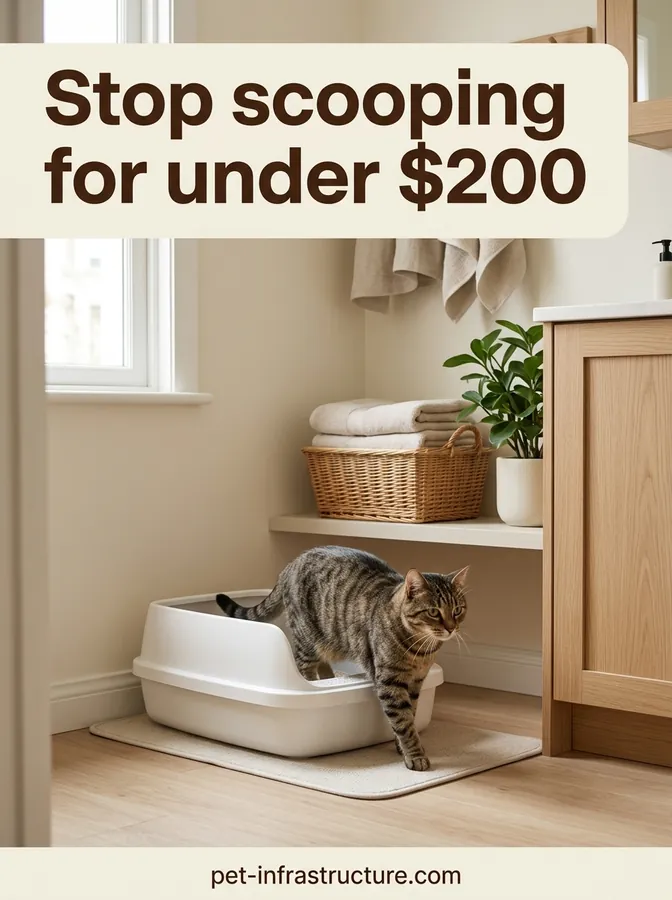
What $200 buys, and what it doesn't
The first thing to know is that almost nobody seriously tests this price range. Cats.com's roundup, updated in September 2026 after testing 38 models, doesn't have a single pick under $200 — its cheapest recommendation costs well above that. Their explanation matches what owners report: cheaper boxes often skimp on the sensors that stop a cycle when a cat steps in, on how reliably they sift, and on after-sale support.
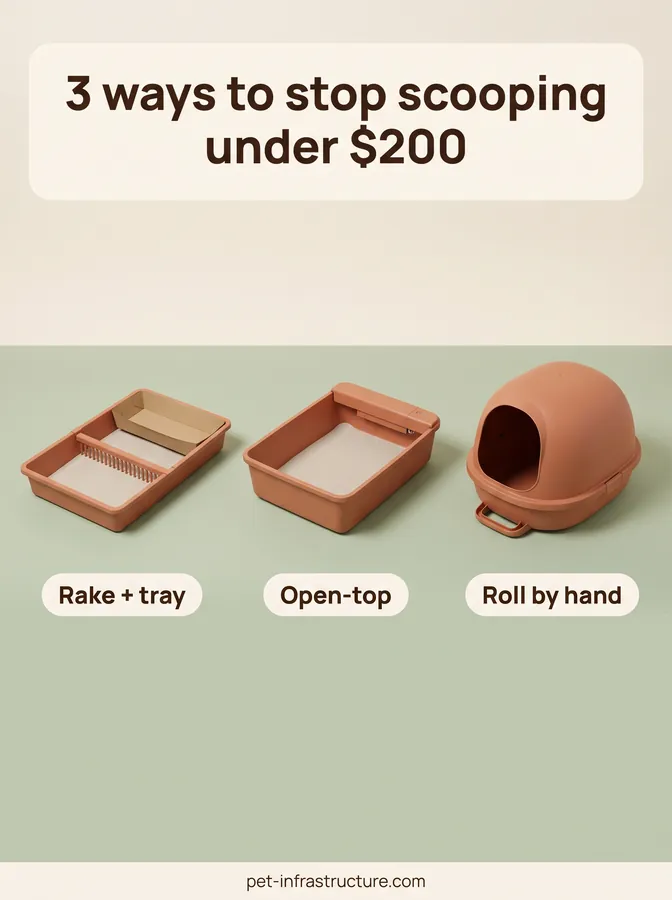
That leaves three realistic paths under $200:
- A rake box with crystal litter trays — automatic, simple, but you pay for the trays forever.
- An open-top box that uses normal clumping litter — closer to a real robot, but only under $200 when it's discounted.
- A box you roll by hand — no motor at all, very cheap, and you still do a ten-second job yourself.
| Design | Example | Litter | Safety | Watch out for |
|---|---|---|---|---|
| Rake box + crystal trays | PetSafe ScoopFree | Proprietary crystal trays | Can't trap a cat — open tray | Tray refills, every one to two weeks per owner reports |
| Open-top box, normal litter | ONEISALL Ease S1 | Your usual clumping litter | Presence sensors stop the cycle | Only under $200 on sale; smaller brand |
| Manual rolling box | Omega Paw Roll'n Clean | Your usual clumping litter | No motor at all | You still roll it once a day |
| Unbranded rotating drum | Many look-alike listings | Varies | Depends entirely on sensors you can't verify | The one type we'd avoid |
If your budget can stretch, our comparison of self-cleaning litter boxes under $700 covers the next tier up.
Rake boxes with crystal trays
The PetSafe ScoopFree line is the one established brand that consistently sells below $200 — the Crystal Pro Legacy was listed between about $120 and $160 across PetSafe, Chewy and Amazon when we checked. The design is simple: a motion sensor notices a visit, waits 20 minutes, and a rake pushes waste to a covered compartment at the end of a disposable tray of crystal litter.
It's a sensible design from a safety point of view — a rake moving across an open tray can't trap a cat the way a closed drum could. The catch is running cost. ScoopFree uses its own crystal trays, and those are where the money goes: owners on Chewy describe swapping trays every one to two weeks, and at retail tray prices that adds up to a large yearly bill for a single cat. Reviewers also mention odor building by the end of the second week, the rake occasionally missing waste, and some cats simply refusing crystal litter.
A rake box makes sense if you want real automation on a tight upfront budget and your cat already accepts crystal litter. Do the yearly tray math before you buy, not after.
Open-top boxes with ordinary litter
A newer group of open-top boxes uses the clumping litter you already buy, with a rake or a slowly rotating sifting screen. The ONEISALL Ease S1 is a good example of the type: stainless sifting screen, an 11-liter waste bin that the brand says lasts up to 14 days for one cat, sensors that stop a cycle when a cat is detected, and a stated weight range of 2.6 to 30 pounds. Its catch is price — it only dips under $200 on sale, and it's sold mainly through its own store and Amazon.
Because they use normal litter, these boxes avoid the trap of proprietary refills. The trade-off is that you're relying on a smaller brand's sensors and support. Reviewers note that the Ease S1's sensors are sensitive enough that it needs a quiet, low-traffic spot to avoid pausing constantly.
The no-motor option: a box you roll
If what you hate is the scooping itself, the cheapest fix doesn't need electricity. The Omega Paw Roll'n Clean is a covered box with a sifting grid built in. Once a day you roll it onto its side and back: the clumps are caught by the grid and slide into a pull-out tray, which you empty. That's it.
It's not automatic, and it won't clean itself while you're away for the weekend. But it uses ordinary clumping litter, has no motor or sensor that can fail, and there is nothing in it that can close on a cat. For many one-cat households, that's the most honest answer to "self-cleaning litter box on a budget".
The budget boxes to avoid
The design to be wary of is the cheap, unbranded rotating drum — the kind that looks like a Litter-Robot at a fraction of the price and is often resold under several different names. In 2024, Hackaday reported cat deaths linked to one such generic box: the drum kept turning with a cat caught in the opening, and its pinch and infrared sensors were only switched on by a later firmware update. We found no official recall, but the pattern is the point: in a closed rotating drum, the safety sensors are the only thing standing between your cat and the mechanism.
If a rotating drum is under $200, from a brand with no track record, and you can't find clear documentation of how it detects a cat and stops, choose a rake box or a manual rolling box instead.
Before you buy any motorized box at this price, check the listing and the manual for four things:
- How it detects your cat — a weight sensor, an infrared sensor, or both — and whether it stops mid-cycle when a cat steps in.
- Anti-pinch protection at every opening that moves.
- A stated weight range for your cat, both minimum and maximum.
- A reachable brand — a support page, a manual you can download, and replacement parts you can actually order.
If a listing doesn't answer all four, that's your answer.
Frequently asked questions
Is there a good self-cleaning litter box under $200?
Yes, but not a Litter-Robot-style drum. Under $200 your realistic options are a rake box with crystal trays like the PetSafe ScoopFree, an open-top box that uses normal clumping litter when it's on sale, or a manual rolling box like the Omega Paw Roll'n Clean. Each saves you scooping in a different way.
Are cheap automatic litter boxes safe?
The design matters more than the price. Rake boxes and manual rolling boxes can't trap a cat. Cheap unbranded rotating drums are the risky type: there have been reports of cat deaths with a generic model whose safety sensors weren't enabled. Avoid a closed drum unless the brand clearly documents how it detects your cat.
Can a cheap self-cleaning litter box handle two cats?
Check the waste capacity the maker states and assume it fills faster with each cat. The ONEISALL Ease S1's 11-liter bin, for example, is rated for up to 14 days with one cat, so plan on emptying it more often with two. With a ScoopFree, more cats mean trays to replace more often, which raises the running cost.
Why is a ScoopFree cheaper than a Litter-Robot?
The machine is simpler — a rake on a timer instead of a rotating globe with weight sensors — and the brand earns on the proprietary crystal trays you keep buying. Over a year, those trays can cost more than the box itself, so compare the running cost, not just the sticker price.
Keep reading
- More articles like this one — buying, running costs and living with these machines.
- The troubleshooting library — if something is actually broken right now, start there instead.

Written by Alberto Guardia
I’m a physician working in medical informatics, and I run Pet Infrastructure on my own — no team, no manufacturer sponsorship, no paid placements. I share my home with Wolfgang, a 13-year-old Chartreux with firm opinions about litter and none whatsoever about firmware.
How this article was put together. Every figure, spec and claim here is traced back to the manufacturer’s own documentation, to official support articles, or to several owner reports that agree with each other — and the article tells you which. Where something genuinely isn’t documented anywhere, I say so instead of filling the gap.
How I check everything I publish → · Last updated October 2026