Litter-Robot 3 vs 4: is the upgrade actually worth it?
One thing to settle before anything else, because most comparisons you'll find still assume otherwise: you can no longer buy a Litter-Robot 3 new from Whisker. Both Litter-Robot 3 Connect product pages on litter-robot.com now carry the same line — "Litter-Robot 3 Connect is no longer available" — with no add-to-cart, and the model is absent from Whisker's current comparison chart, which lists only the 5 Pro, the 5, the 4 and the EVO. Whisker still sells parts for it, and remaining new stock has been turning up through its Amazon storefront, but the 3 is out of the lineup.
That changes the question. This isn't "which of the two should I buy" any more — it's "I own a Litter-Robot 3, do I keep fixing it or move to a 4." Here's what actually changed between the two, from Whisker's own published specs rather than marketing copy, and when fixing the 3 you already own is still the better move.
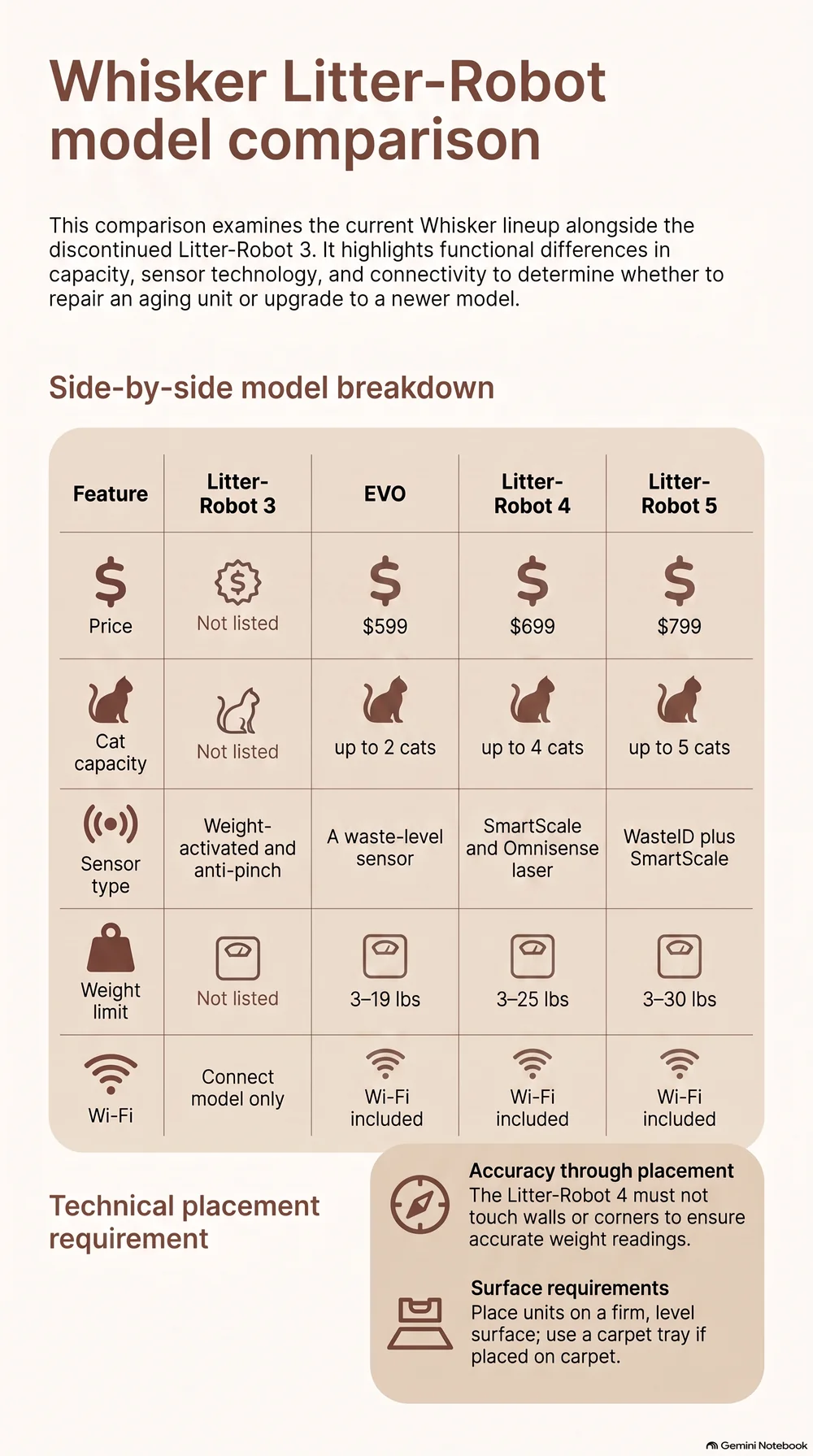
What actually changed
Whisker's own comparison lays out four real differences, not cosmetic ones:
- Cat sensing. The 3 uses weight-activated sensors plus anti-pinch. The 4 adds SmartScale weight detection — Whisker's wording is that it "detects the weight of individual cats that weigh a difference of 1 or more pounds," so it separates cats in the app only if they're at least a pound apart — and an enhanced SafeCat System with Omnisense detection, which reads four safety zones with lasers. The 3 has no laser sensing at all.
- Entryway width. The 3's globe opening is 10.25" wide. The 4's is 15.75" — a real difference for a larger cat, not a marketing number.
- Waste drawer capacity. The 4's drawer holds about 20% more *usable* volume (637 in³ vs 536 in³ on the 3), which in practice means fewer trips to empty it. Worth flagging where those numbers come from, because the manuals look like they say the opposite: Whisker's figures measure usable interior fill space, while the dimensions tables in the manuals give the drawer's external size, and the 3's external figure includes structure that isn't fillable.
- Noise. The 4 uses what Whisker calls QuietSift, described officially as "dramatically reduc[ing] motor noises." Whisker publishes no decibel figure for either model, so treat this as a real but unquantified difference — it matters if the unit sits near a bedroom or a shared wall, and you shouldn't buy on a number nobody published.
On connectivity, be careful which 3 you're comparing: the Litter-Robot 3 Connect is WiFi-enabled and still supported in the current Whisker app, but the plain Litter-Robot 3 has no WiFi at all — it needed a separate Connect upgrade kit. The 4 is app-connected in every configuration.
As for price: the Litter-Robot 4 lists at $699, and Whisker has been stocking reconditioned 4s at $599. The old $549 figure still visible on the dead Litter-Robot 3 Connect page is a leftover on a page you can't buy from, so there's no live price gap left to compute. The comparison that matters now is a repair bill against $599–$699.
What we know about reliability
This is the part most comparisons skip, and it's worth being honest about what's actually documented rather than what sounds reassuring. For the Litter-Robot 4, we've compiled a full reliability report from warranty terms, verified-purchase reviews, and community reports: a motor assembly runs $55 to replace, a full globe with liner is $185, a liner alone is $70, and the one documented out-of-warranty base replacement case came to $399. WhiskerCare's optional $100 extension covers 3 years total, base included.
For the Litter-Robot 3, we don't have an equivalent full failure-rate breakdown — what's documented and confirmed is narrower: a motor jam that keeps returning after basic checks (litter level, gear set screw, glider buttons) usually points to the motor assembly itself, which Whisker sells directly for $48.
That gap in documentation isn't nothing — it means we can tell you what a Litter-Robot 4 repair typically costs, but we can't yet give you the same confidence about the 3's other components the way we can for the 4.
Repair the 3, or upgrade to the 4
If your Litter-Robot 3's only problem is a motor jam that keeps coming back after you've ruled out overfilled litter, a loose gear, or dirty glider buttons, a $48 official motor assembly is the cheaper fix by a wide margin — we walk through the full diagnosis and replacement in a separate guide dedicated to that exact repair.
The upgrade starts to make more sense when the unit is stacking up more than one age-related issue at once — a motor problem alongside worn seal strips, a sensor that's started misreading, or a globe liner that no longer seats properly. At that point you're not comparing $48 against $699; you're comparing the cost of repeatedly patching an aging unit against a fresh Litter-Robot 4 with its own WhiskerCare 1-year warranty, extendable before it expires by two more years for $100, for three years total. And a new machine is not only its purchase price: our Litter-Robot running-cost calculator adds the filters, liners and power the 4 would carry for as long as you keep it.
Discontinuation cuts both ways here, and it's worth being precise rather than alarming about it. Whisker still sells Litter-Robot 3 parts — the motor assembly, the DFI sensor, the pinch sensor, the gear, the WiFi module are all individually orderable today — so a working 3 is not suddenly unmaintainable. What you no longer have is a route back to a *new* unit under warranty if the base itself goes. That's the risk that grows with each year you keep patching, not the availability of a single part.
Who should skip the upgrade
The upgrade doesn't pay for itself in every household. Whisker's own comparison page — written while the 3 was still on sale, and still live at the time of writing — named three cases where it said to stay with the 3: you only have one cat, you don't want to use an app, and a slightly louder motor doesn't bother you or your cat. Those three still describe a real household; the only thing that's changed is that Whisker no longer has a 3 to sell you.
So if your cat is on the smaller side and comfortably clears the 3's narrower entryway, and the unit hasn't shown a pattern of repeat failures, there's nothing here that says you need to replace a working machine. Buy the part, not the robot.
Frequently asked questions
Can you still buy a Litter-Robot 3?
Not new from Whisker. Both Litter-Robot 3 Connect pages on litter-robot.com now say "Litter-Robot 3 Connect is no longer available," with no add-to-cart, and the model has been dropped from Whisker's current comparison chart. Replacement parts are still sold, and remaining new stock has been appearing through Whisker's Amazon storefront, but the 3 is no longer part of the lineup. If you're buying today, the entry-level Whisker is the EVO at $599.
Is the Litter-Robot 4 quieter than the 3?
Yes, though not by a published number. Whisker markets the 4's QuietSift technology as "dramatically" reducing motor noise, and describes the 4's cycle as whisper-quiet, while the 3's motor runs audibly louder. Neither model has a decibel rating published by Whisker, so anyone quoting you one is guessing.
How much bigger is the Litter-Robot 4's entryway than the 3's?
The 4's opening is 15.75" wide; the 3's is 10.25" wide. That's the single biggest physical difference between the two models, and it matters most for larger cats.
Can I fix a Litter-Robot 3 motor jam instead of upgrading?
Often, yes. If the jam keeps returning after checking litter level, the gear set screw, and the glider buttons, a $48 official motor assembly replacement is documented to resolve it — see our step-by-step repair-or-upgrade guide for the full diagnosis.
Does the Litter-Robot 4 hold more waste than the 3?
Yes, about 20% more usable volume (637 in³ versus 536 in³ of fillable interior space), which in practice means the waste drawer needs emptying less often. Don't try to check this against the manuals' dimensions tables — those give the drawer's external size, which is measured differently and reads the other way round.
Keep reading
- More articles like this one — buying, running costs and living with these machines.
- The troubleshooting library — if something is actually broken right now, start there instead.

Written by Alberto Guardia
I’m a physician working in medical informatics, and I run Pet Infrastructure on my own — no team, no manufacturer sponsorship, no paid placements. I share my home with Wolfgang, a 13-year-old Chartreux with firm opinions about litter and none whatsoever about firmware.
How this article was put together. Every figure, spec and claim here is traced back to the manufacturer’s own documentation, to official support articles, or to several owner reports that agree with each other — and the article tells you which. Where something genuinely isn’t documented anywhere, I say so instead of filling the gap.
How I check everything I publish → · Last updated August 2026