Why does my Litter-Robot still smell after cleaning?
If you've already done the deep clean — globe, drawer, fresh litter — and the smell is still there within a day or two, the plastic isn't the problem. Self-cleaning litter boxes have one or two specific places odor hides that a normal cleaning routine never touches, and which one applies to you depends on your model and exactly when the smell shows up. Here's how to actually diagnose it instead of repeating the same clean and hoping.
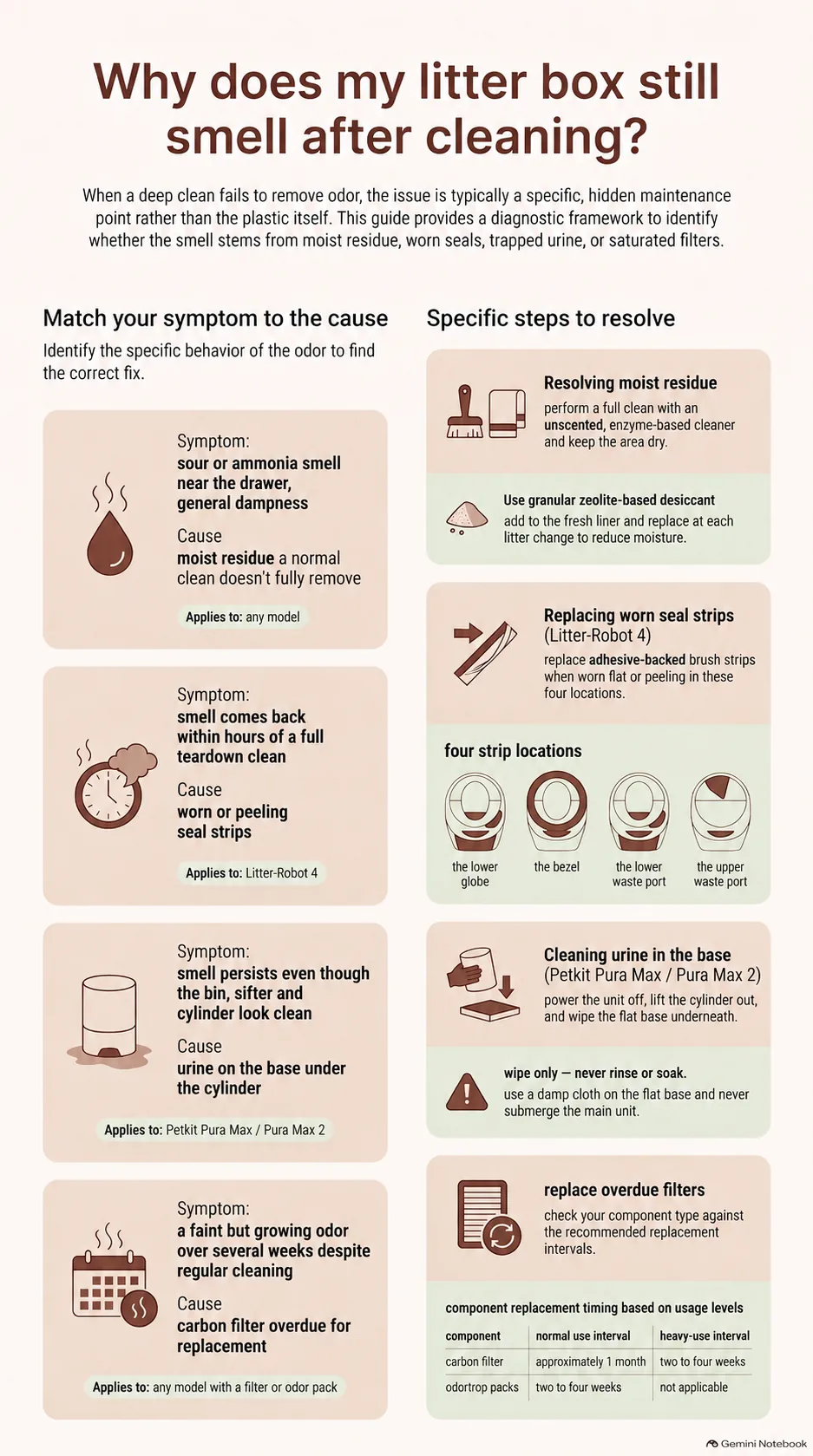
Quick diagnosis: match your symptom to the cause
| What you're noticing | Likely cause | Applies to |
|---|---|---|
| Sour or ammonia smell near the drawer, general dampness | Moist residue that a normal clean doesn't fully remove | Any model |
| Smell comes back within hours of a full teardown clean | Worn or peeling seal strips at the lower globe, bezel, or either waste port | Litter-Robot 4 |
| Smell persists even though the bin, sifter, and cylinder look clean | Urine on the base under the cylinder — from a torn inner mat, or from the rotation setting | PETKIT Pura Max / Pura Max 2 |
| A faint but growing odor over several weeks despite regular cleaning | Carbon filter is overdue for replacement | Any model with a filter or odor pack |
| Small flies around the unit, not just a smell | Phorid flies breeding in moist residue — a related but separate problem | Any model |
Moist residue: the cause behind most odor complaints
Before checking anything model-specific, rule out the most common cause: litter clumps that break down against the globe or cylinder wall, or a drawer that sits a day or two past its normal schedule, leave behind a damp organic film that a quick wipe-down doesn't fully remove. It doesn't take a visible mess — a few days of moisture in the wrong spot is enough to start smelling. On a Litter-Robot 4, litter that's slow to clump or too coarse to sift properly makes this worse; our litter compatibility guide covers which brands clump fast and clean, and which ones leave residue behind.
The fix is the same regardless of brand: a full clean with an unscented, enzyme-based cleaner to break down the residue rather than mask it, then keeping the area dry afterward. A zeolite-based desiccant added to the fresh liner reduces the standing moisture and adsorbs ammonia going forward, which is what keeps the smell from rebuilding rather than just removing what's already there. Use the granular form rather than a powder, replace it at each litter change once it's saturated, and apply cleaner to a cloth rather than spraying the unit — Whisker's rule for the Litter-Robot 4 base, and sound practice on any brand.
Litter-Robot 4: check the seal strips before anything else
If you own a Litter-Robot 4 and the smell returns within hours of a genuinely thorough clean, the seal strips are the part of the machine worth inspecting first, because they're the only odor path a normal clean never touches. Whisker documents them in the Litter-Robot 4 manual and its use-and-care guide: thin, adhesive-backed brush-type strips sitting in four places — the lower globe, the bezel, the lower waste port and the upper waste port. Whisker's stated job for them is to help reduce odor and stop litter and waste leaking between parts, and its stated replacement trigger is plain: replace them when they're worn flat or peeling off.
One honest caveat before you go further: Whisker doesn't claim a worn strip causes an odor problem, and it notes the strips aren't required for the machine to function — so this is the thing to check, not a diagnosis in itself.
The good news is on cost. Whisker's own seal strip product pages answer the warranty question directly: if your Litter-Robot is still under warranty, contact Whisker Customer Experience for repair or replacement. So before you buy anything, check your purchase date and send a message.
Out of warranty, Whisker sells the strips as a variety pack covering all four locations, and also individually — if only one zone is worn, you don't need the full pack. One thing worth avoiding either way: spraying cleaner directly onto the base gets the strips wet, and Whisker warns that dampness is what makes them start to peel. Spray a cloth instead — which also keeps liquid off the base electronics and sensors, Whisker's second reason for the same rule. The full inspection and replacement walkthrough, including exactly where each of the four strip locations sits, is in our complete seal strip guide.
PETKIT Pura Max: the smell is under the cylinder, not in the bin
Pura Max owners run into a different mechanism entirely, and PETKIT documents two separate routes to the same result: urine ending up on the base underneath the cylinder, a surface no routine cleaning ever reaches. The waste bin stays clean, the app reports normal cycles, and the smell keeps coming from somewhere you're not looking. (If you're still deciding between a Pura Max and a Litter-Robot, our Pura Max cost-of-ownership breakdown covers this alongside price, running costs and warranty.)
The first route is the mundane one, and it's the one PETKIT's own support article on urine leakage points to: a torn inner mat, or a gap between the inner mat and the cylinder, lets urine through. PETKIT's fix there is to use less litter and seal the gap. Check the mat before anything else — it's the fastest thing to rule out.
The second is the setting. If Uninterrupted Rotation is switched off, the machine stops mid-cycle when it senses a cat approaching, and PETKIT's manual warns that if the cylinder opening is facing downward at that moment, another cat can enter — with its urine draining into the bottom of the device. Turning Uninterrupted Rotation on in the PETKIT app stops that route.
Either way, the cleanup is the same: power the unit off, lift the cylinder out, and wipe the flat base underneath with a damp cloth. PETKIT is categorical that the main unit body must never be rinsed or soaked — wiping only. If you find a wet film, a dried ring, or dark staining down there, that confirms it. The full step-by-step, including how to safely remove the cylinder on both the original Pura Max and the Pura Max 2, is in our Pura Max base-cleaning guide.
What the carbon filter actually does
Separately from either of the causes above, most self-cleaning litter boxes use a carbon filter or an equivalent odor pack that quietly stops working long before it looks dirty. On the Litter-Robot 4, Whisker's use-and-care guide says a filter "should last approximately 1 month" under normal use and adds that replacement frequency is up to you and your cats' usage patterns — its general FAQ gives a tighter two to four weeks. Treat monthly as the default and two to four weeks as the shorter end: heavier use or a multi-cat household saturates it faster, light use stretches it longer, and returning odor is the real trigger rather than the date on the calendar.
Whisker's OdorTrap packs target the same problem by a completely different route — a blend of plant oils including cedarwood oil, rather than activated carbon. Whether you can run both at once, Whisker answers two ways: its OdorTrap installation guide says the carbon filter and OdorTrap packs cannot be used together, while its general FAQ suggests combining them. On the Litter-Robot 4 the holder clips in where the carbon filter goes, so in practice you remove the filter to fit it — follow the installation guide. Either way, OdorTrap runs on a shorter clock, every two to four weeks rather than monthly. One thing Whisker publishes that retailers rarely repeat: because OdorTrap contains essential oils, Whisker advises watching how your cat reacts and discontinuing use if any irritation appears.
If you've already ruled out seal strips or a base leak and there's still a faint odor that's been slowly building for weeks, an overdue filter is the next thing to check — it's the cheapest and easiest cause to rule out, and our carbon filter replacement guide covers exactly where it sits and how to swap it.
A prevention routine that actually holds
Once you've fixed whichever cause applies to you, the routine that keeps odor from coming back is short: wipe visible surfaces with a cloth (not a direct spray) after each clean, replace the carbon filter around the one-month mark — or the OdorTrap pack every two to four weeks if you use those instead — rather than waiting for a smell to remind you, and do a full enzyme-cleaner pass every one to three months to break down anything that's built up in seams and crevices. If you start noticing small flies rather than just an odor, that's a related but separate problem — moist residue left too long can attract phorid flies, and our phorid fly guide covers that specific fix.
Frequently asked questions
Why does my Litter-Robot smell bad even right after I clean it?
Check when the smell returns. Within hours, on a Litter-Robot 4, worn seal strips are the first thing to inspect — they're not part of a standard clean, and Whisker's own trigger for replacing them is when they're worn flat or peeling. On a PETKIT Pura Max, check under the cylinder for urine that's leaked into the base, and check the inner mat for tears or a gap. On any model, an overdue carbon filter or a spot of moist residue the clean missed are the next things to rule out.
Is it safe to use isopropyl alcohol to clean my litter box?
It isn't what Whisker recommends. Its documented cleaners are the Litter-Robot cleaner spray or wipes, water with a mild soap, or an unscented enzyme-based cleaner, and it explicitly rules out bleach inside the globe. The one place Whisker does specify rubbing alcohol is narrow: removing leftover adhesive residue before fitting new seal strips. If you use it anyway, keep it off the seal strips — alcohol dissolves the adhesive holding them on — keep it away from the base electronics and the sensor lenses, apply it to a cloth rather than spraying, and let it dry off completely before your cat comes back. Isopropyl alcohol is rated a moderate-risk toxin for cats.
How often should I replace the carbon filter?
Whisker's use-and-care guide says approximately one month under normal use; its general FAQ says every two to four weeks. Treat it as a benchmark rather than a deadline — replace sooner if odor returns, later if your household is light use. Whisker also notes that scented litter shortens the interval, since the filter absorbs the fragrance along with the odor.
My litter box smells fine but there are small flies around it — is that the same problem?
Related, not the same. Flies mean moisture has been sitting long enough to breed, which is a more advanced version of the residue problem above. It has its own fix — a drying-focused routine rather than just a clean — covered in our phorid fly guide.
Does the type of litter I use affect the smell?
Yes, indirectly. Litter that clumps slowly or doesn't clump at all leaves more moist residue behind for longer, which is the single biggest cause of lingering odor across every model. A fast-clumping, low-dust clay litter reduces how much residue builds up in the first place; see our litter compatibility guide for which brands do that reliably in a Litter-Robot 4.
Does a persistent smell mean my unit is defective?
Almost never. Every cause in the table above — moist residue, worn seal strips, a base leak, an overdue filter — is a maintenance issue with a documented fix, not a manufacturing defect. Work through the diagnosis by symptom before assuming the machine itself is at fault.
Keep reading
- More articles like this one — buying, running costs and living with these machines.
- The troubleshooting library — if something is actually broken right now, start there instead.

Written by Alberto Guardia
I’m a physician working in medical informatics, and I run Pet Infrastructure on my own — no team, no manufacturer sponsorship, no paid placements. I share my home with Wolfgang, a 13-year-old Chartreux with firm opinions about litter and none whatsoever about firmware.
How this article was put together. Every figure, spec and claim here is traced back to the manufacturer’s own documentation, to official support articles, or to several owner reports that agree with each other — and the article tells you which. Where something genuinely isn’t documented anywhere, I say so instead of filling the gap.
How I check everything I publish → · Last updated August 2026