Dog ramp vs dog stairs: which one for the bed or couch?
Your dog has always jumped onto the bed. Then one evening they hesitate, or land awkwardly, or a new puppy keeps trying and failing. Dog ramps and dog stairs both solve the same problem, but they don't suit the same dog or the same bedroom. The choice comes down to three things: your dog's body, your floor space, and the height you need to reach. Most guides stop at "ramps are gentler". This one also gives you the one number nobody prints: how long a ramp actually has to be for your bed.
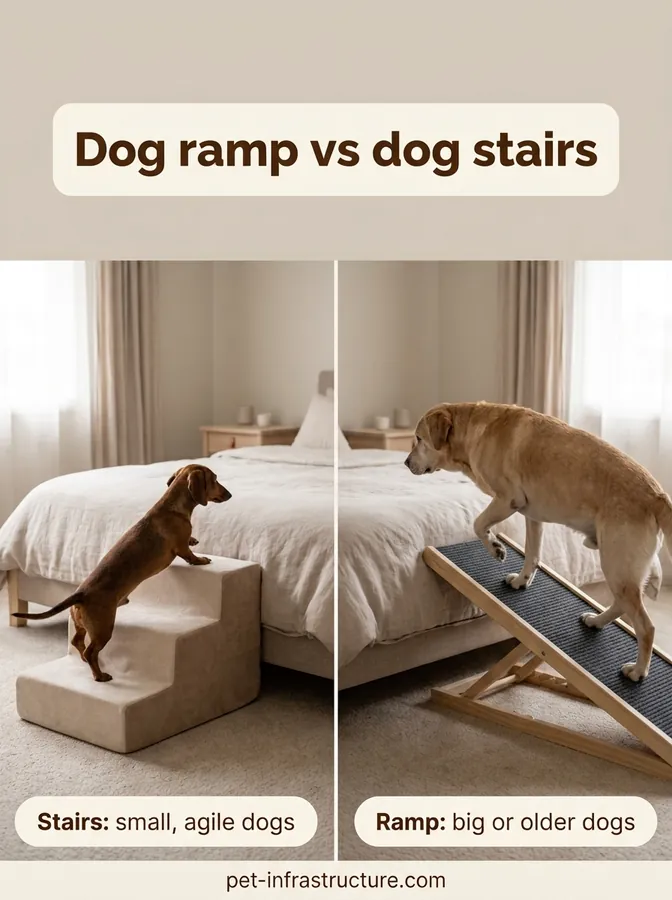
The short answer: stairs suit small, agile dogs and tight rooms, because they reach a given height in less floor space. Ramps suit larger dogs, older dogs and long-backed breeds, because they replace the climb with a gentle slope — PetMD's vet-reviewed guide recommends a ramp over stairs for dogs with arthritis. A ramp only works if it's long enough: at a 20° slope, reaching a 24-inch bed takes a ramp about 70 inches long, and the ramp covers about 66 inches of floor. If you don't have that space, stairs are the realistic option. Ask your vet if your dog has a back or joint condition.
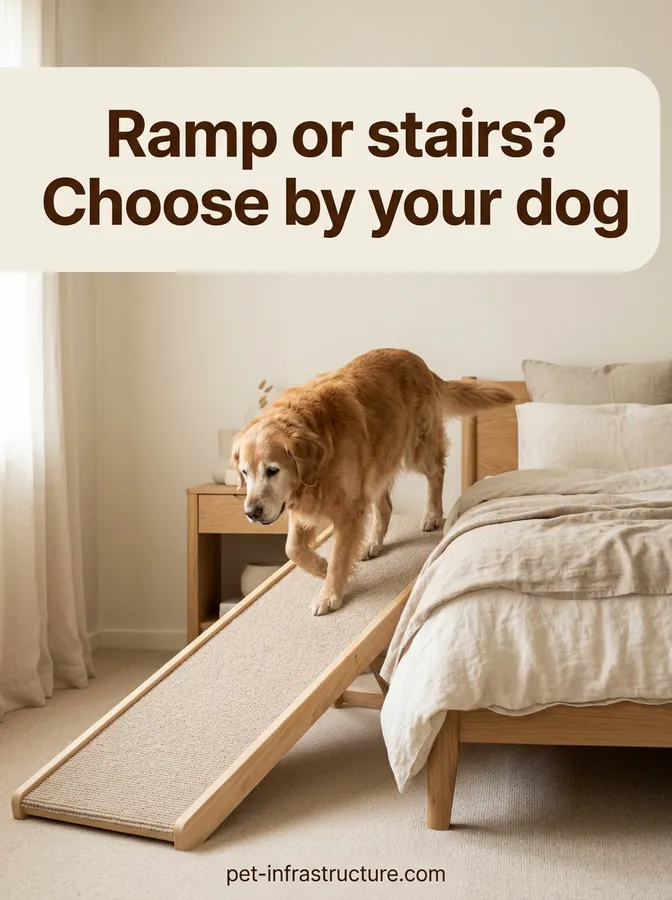
Signs your dog could use one
Vet-written guides list the same situations where a ramp or stairs helps. PetMD names older dogs, dogs with back disc disease (IVDD), dogs with a luxating kneecap, and dogs recovering from surgery on a hip or leg. Pet Circle, whose guide is written by a veterinarian, adds that it's easier to bring in a ramp or stairs before your dog starts to struggle than after. Puppies with bones still developing are another common case. If any of these apply, ask your vet which option suits your dog — this guide covers the equipment side.
Stairs or ramp: the quick decision
| Your situation | Usually the better fit | Why |
|---|---|---|
| Small, agile dog, couch or low bed | Stairs | Compact, and small dogs generally manage steps well (PetMD) |
| Medium or large dog | Ramp | Easier on joints than a series of steps (PetMD) |
| Senior dog or arthritis | Ramp | A mild incline, no impact — ask your vet |
| Long-backed breed (Dachshund, Corgi, Basset) | Either, with your vet's advice | The AKC notes these breeds are predisposed to back disc problems; the goal is to stop the jumping |
| Puppy that keeps jumping | Either, sized to the adult dog | Growing bones benefit from less jumping (FitBark, vet-reviewed) — ask your vet |
| Small bedroom | Stairs | A ramp for a tall bed needs several feet of floor |
| You need to put it away during the day | Folding ramp | The AKC points out ramps fold more compactly; stairs are bulkier to store |
How long does a dog ramp need to be?
This is the part that decides whether a ramp is even possible in your room. The steeper the ramp, the shorter it is — and the harder it is for your dog. A physical therapist writing on veterinarian Patrick Mahaney's site suggests about 18 to 20 degrees for toy and small dogs and 22 to 25 degrees for medium dogs.
The table below gives the ramp length you need, and how much floor it covers, for common bed and couch heights. Measure from the floor to the top of the mattress or seat cushion.
| Height to reach | Ramp length at 18° | Ramp length at 20° | Ramp length at 25° | Floor used at 20° |
|---|---|---|---|---|
| 12 in (low couch) | 39 in | 35 in | 28 in | 33 in |
| 16 in (couch) | 52 in | 47 in | 38 in | 44 in |
| 18 in | 58 in | 53 in | 43 in | 49 in |
| 20 in | 65 in | 58 in | 47 in | 55 in |
| 24 in (standard bed) | 78 in | 70 in | 57 in | 66 in |
| 30 in (tall bed) | 97 in | 88 in | 71 in | 82 in |
The calculation is simple if your height isn't in the table: ramp length equals the height divided by the sine of the angle, and the floor it covers equals the height divided by the tangent. Many sites get this wrong and understate how long a ramp has to be.
What to look for in either one
The AKC's buying advice for both ramps and stairs comes down to a few points worth checking on any product page:
- Grip. A non-slip surface — carpet or rubber — so paws don't slide, going up or coming down.
- Width. Wide enough for your dog to walk straight up without stepping off the edge.
- Stability. Nothing that shifts when a dog steps on it. Put a ramp against the bed on one side if you can; the AKC suggests a barrier on at least one side.
- Deep steps. For stairs, FitBark's vet-reviewed guide notes that deeper steps are easier for a dog to use.
- Weight capacity. Check it against your dog's weight with a margin, especially for foam stairs.
- Height match. The top step or the top of the ramp should land at the height of the mattress, not below it.
Our picks
Ramps and stairs come in a few families. Foam stairs are light and need no assembly. Wooden ramps are sturdier and carry heavier dogs. Folding and telescoping ramps pack away, which is also why they're the usual choice for getting a dog into a car or SUV, as Rover's and PetMD's guides note. For the bed and the couch, two picks cover most homes.
Our choice for most dogs and beds: the PetSafe CozyUp Bed Ramp. It reaches 25 inches, carries up to 120 lb, and its carpeted surface gives grip. PetSafe lists it at 70 inches long, which works out to a slope of about 21 degrees — close to the gentle end of the range above.
For a small dog and a couch or a lower bed: foam stairs. The Best Pet Supplies 4-step version reaches 18 inches, needs no assembly, and takes far less floor than a ramp to the same height.
Getting your dog to use it
Most dogs don't trust a ramp or stairs on day one. The AKC recommends starting at a low angle and raising it as your dog gains confidence. Put the ramp or stairs in place, walk your dog up with a treat a few times a day, and let them go at their own pace. Once they use it on their own, block the old jumping route so the new way becomes the habit.
Sharing the house with an older cat too? The same logic applies to its litter box — see our guide to the self-cleaning litter box for a senior cat.
Frequently asked questions
Is a ramp or stairs better for a dog?
It depends on the dog and the room. Stairs suit small, agile dogs and small spaces. Ramps suit larger or older dogs, because a mild slope avoids the impact of climbing steps. PetMD recommends a ramp over stairs for dogs with arthritis. Ask your vet if your dog has a back or joint condition.
How long should a dog ramp be for a bed?
For a standard 24-inch bed, a ramp needs to be about 70 inches long at a 20-degree slope, and it covers about 66 inches of floor. At 25 degrees it can be about 57 inches long, but the climb is steeper. Divide the height by the sine of the angle to get the length for your bed.
What angle should a dog ramp be?
A physical therapist writing on a veterinarian's site suggests about 18 to 20 degrees for toy and small dogs and 22 to 25 degrees for medium dogs. The lower the angle, the easier the climb and the longer the ramp.
Do dogs prefer steps or a ramp?
It varies by dog. Small, agile dogs usually take to stairs quickly, while larger, older or stiff dogs are often more comfortable on a ramp's gentle slope, as PetMD notes. Whichever you choose, most dogs need a few days of encouragement with treats.
What is an alternative to a dog ramp?
Dog stairs are the main alternative when floor space is tight. Otherwise, a dog bed on the floor next to your bed, or keeping your dog off tall furniture, removes the need to climb at all.
Do dog stairs help dogs with back problems?
Stairs and ramps both stop the jumping that strains a dog's back, which is why the AKC mentions them for breeds prone to disc problems such as Dachshunds and Corgis. Which one is better for your dog is a question for your vet.
Keep reading
- More articles like this one — buying, running costs and living with these machines.
- The troubleshooting library — if something is actually broken right now, start there instead.

Written by Alberto Guardia
I’m a physician working in medical informatics, and I run Pet Infrastructure on my own — no team, no manufacturer sponsorship, no paid placements. I share my home with Wolfgang, a 13-year-old Chartreux with firm opinions about litter and none whatsoever about firmware.
How this article was put together. Every figure, spec and claim here is traced back to the manufacturer’s own documentation, to official support articles, or to several owner reports that agree with each other — and the article tells you which. Where something genuinely isn’t documented anywhere, I say so instead of filling the gap.
How I check everything I publish → · Last updated October 2026