Self-cleaning litter box for a senior cat: what actually matters
Older cats change how they use the litter box long before anything looks wrong. They hesitate at the edge, step in more carefully, or start going just outside it. If you're thinking about a self-cleaning litter box for a senior cat, the features on the box matter less than one plain question: can your cat get in easily, every time, on a stiff morning? This guide compares the step into each machine, the weight limits, and the tracking features that help you notice changes — without pretending a box can replace your vet.
The short answer: for a senior cat, pick the box with the lowest, easiest entry you can find and add a ramp or step if one is offered. Vet-reviewed guides suggest an entry of around 5 inches or lower. Every Litter-Robot sits a little above that — 5.6 inches for the EVO, 6.9 for the Litter-Robot 4 and 7 for the Litter-Robot 5 — which is why Whisker's ramp matters. The open-top PETLIBRO Luma avoids the hood but its entrance sits 13.4 inches up, so it relies on its included step. Cornell's Feline Health Center advises low sides for elderly cats and a box on every floor they use. Ask your vet about any change in your cat's litter habits.
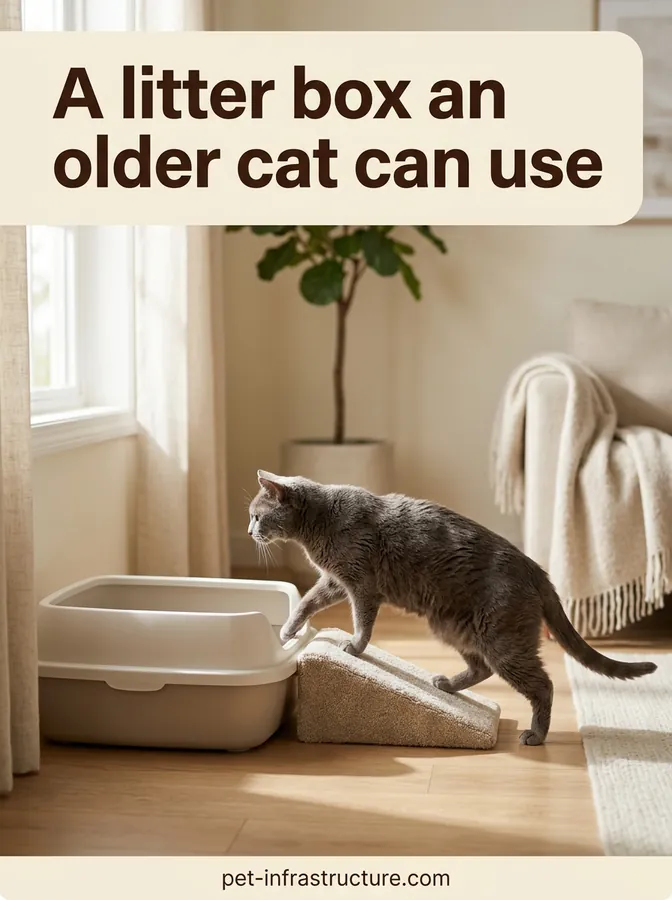
What an older cat needs from any litter box
The advice from feline specialists is simple, and it applies to a robot just as much as to a plastic tray:
- Low sides. Cornell's Feline Health Center says elderly cats and cats with mobility problems need boxes with low sides. It notes that some older cats will still climb into a normal box to urinate, but not to defecate.
- Close by, on every floor. Cornell advises a box on every floor the cat uses, so it never has to climb stairs to reach one.
- An entry they can walk into. Catster's vet-reviewed guide says the entry should be around five inches, so a cat can walk in instead of jumping.
- Room to turn around. The feline house-soiling guidelines from the AAFP and ISFM recommend a box about one and a half times the cat's length, from nose to base of tail.
- Open, quiet and always reachable. Most cats prefer an uncovered box with a view around them, in a quiet spot away from food, according to Cornell — plus one box per cat, and one extra.
A self-cleaning box helps with one thing older cats care about a lot: a clean box every time. It can make entry harder, though, because most sit higher than a simple tray — every model in the table below is above that five-inch mark. That's the trade-off to manage, and it's what a ramp or step is for.
Self-cleaning boxes compared for older cats
| Model | Step into the box | Cat weight | Ramp or step |
|---|---|---|---|
| Litter-Robot EVO | 5.6 in — lowest in Whisker's range | 3 to 19 lb | Whisker ramp available |
| Litter-Robot 4 | 6.9 in | 3 to 25 lb | Whisker ramp available |
| Litter-Robot 5 / 5 Pro | 7 in | 3 to 30 lb | Whisker ramp available |
| PETLIBRO Luma | Open top; entrance 13.4 in above the floor | Up to 22 lb; auto-clean not advised under 2.2 lb | Step included "for smaller or senior cats" |
Two details matter for older cats in particular. First, every automatic box has a minimum weight for its cat detection — 3 lb for the Litter-Robot range. A thin senior cat is usually well above that, but it's worth knowing. Second, the ramp is often what makes the difference: the EVO manual itself suggests using the Litter-Robot Ramp to make access easier for older or mobility-challenged cats.
Our picks
Our choice for a senior cat: the Litter-Robot EVO. At 5.6 inches, it has the lowest step of Whisker's current machines, and the EVO manual itself recommends Whisker's ramp for older or mobility-challenged cats. It's the most compact Litter-Robot, sized for one or two cats up to 19 lb, and Whisker's app keeps a 7-day history of visits.
If your cat hates covered boxes: the PETLIBRO Luma. Its open top means no hood to duck under, and its app tracks each cat's visits separately. There's a catch for older cats, though: PETLIBRO puts the entrance 13.4 inches above the floor. The Luma comes with a step designed for smaller or senior cats, but watch your cat use it for a few days before you retire the old box.
If you want to follow weight closely: the Litter-Robot 5. Its step is higher, at 7 inches, so plan on the ramp. In return, its built-in scale identifies each cat, which lets you follow each cat's weight over time without lifting anyone onto a bathroom scale. It's sold by Whisker directly rather than on Amazon.
Introducing the new box to an older cat
Older cats don't love change, so take the switch slowly. Whisker's own manual lays out a gentle routine that works for any self-cleaning box:
- Start with it switched off. Let your cat use it as an ordinary litter box first, so the motor doesn't startle them.
- Put it next to the old box, with your usual litter and a scoop of used litter from the old box so it smells familiar. Clean the old box a little less often, and the clean new one becomes more tempting.
- Add the ramp from day one — the EVO manual specifically suggests it for older or mobility-challenged cats.
- Turn on automatic cleaning once your cat uses it regularly, and let them watch a first cycle while you're there to reassure them.
- Keep the old box until the new one is used every time.
Catster also suggests a mat in front of the box, especially on hardwood floors, so older paws have grip getting in and out.
What the apps can and can't tell you
For an older cat, the most useful thing a connected litter box does isn't cleaning. It's noticing. According to the manufacturers:
- Whisker's app (Litter-Robot 4, 5 and EVO) keeps a 7-day history of visits, for one or several cats. The Litter-Robot 5 adds per-cat weight from its built-in scale.
- PETLIBRO's Luma app recognizes up to 10 cats and tracks each one's litter box use, and PETLIBRO says its camera can tell urine from stool.
None of this is a diagnosis. What it gives you is a record: more visits than usual, fewer visits, a weight that drifts over a few weeks. Those are exactly the things worth mentioning to your vet, with the app history on your phone.
When a simple low box is the better answer
Sometimes the honest recommendation is not a machine at all. If your cat has trouble stepping over even a low edge, a very low-entry box is kinder than any robot. Cornell even suggests a large baking sheet for cats that struggle. Many owners keep one low box on each floor alongside the self-cleaning one.
The KittyGoHere Senior Cat Litter Box is designed for exactly that: a large box with a low entrance, made for senior and arthritic cats.
Living with an older dog as well? The same idea — making the climb easier — applies to the bed and the couch: see our guide on dog ramp vs dog stairs.
Frequently asked questions
What is the best litter box for a senior cat?
One with low sides, an easy entry and enough room to turn around, placed on every floor your cat uses, as Cornell's Feline Health Center advises. Among self-cleaning boxes, the Litter-Robot EVO has the lowest step of Whisker's range at 5.6 inches, and Whisker's ramp makes it easier still. The open-top PETLIBRO Luma avoids a hood, but its entrance sits 13.4 inches above the floor, so it depends on its included step.
Can an older cat use a Litter-Robot?
Yes, if it can manage the step: 5.6 inches on the EVO, 6.9 inches on the Litter-Robot 4 and 7 inches on the Litter-Robot 5. Whisker sells a ramp that makes entry easier, and the EVO manual recommends it for older or mobility-challenged cats. The cat must weigh at least 3 lb.
What entry height is best for a senior cat's litter box?
Around five inches or lower, according to Catster's vet-reviewed guide, so the cat can walk in instead of jumping. Self-cleaning boxes sit a little higher — 5.6 inches for the Litter-Robot EVO, the lowest in Whisker's range — so add the ramp or step the maker offers.
Should an old cat have a covered or an open litter box?
Most cats prefer an uncovered box that lets odors escape and gives a view all around, according to Cornell. For an older cat, an open top also means no hood to duck under.
Why did my older cat stop using the litter box?
Sometimes the box has become hard to reach — high sides, stairs, a covered hood. But a change in litter habits in an older cat can also have a medical cause, so Cornell's Feline Health Center advises talking to your vet first, then making the box easier to use.
Can a smart litter box tell me if my senior cat is sick?
No. It can record changes — how often your cat visits, and on some models its weight — which are useful to share with your vet. Any change in litter habits in an older cat is worth a call to your vet.
Keep reading
- More articles like this one — buying, running costs and living with these machines.
- The troubleshooting library — if something is actually broken right now, start there instead.

Written by Alberto Guardia
I’m a physician working in medical informatics, and I run Pet Infrastructure on my own — no team, no manufacturer sponsorship, no paid placements. I share my home with Wolfgang, a 13-year-old Chartreux with firm opinions about litter and none whatsoever about firmware.
How this article was put together. Every figure, spec and claim here is traced back to the manufacturer’s own documentation, to official support articles, or to several owner reports that agree with each other — and the article tells you which. Where something genuinely isn’t documented anywhere, I say so instead of filling the gap.
How I check everything I publish → · Last updated October 2026