How to keep a dog's water from freezing outside
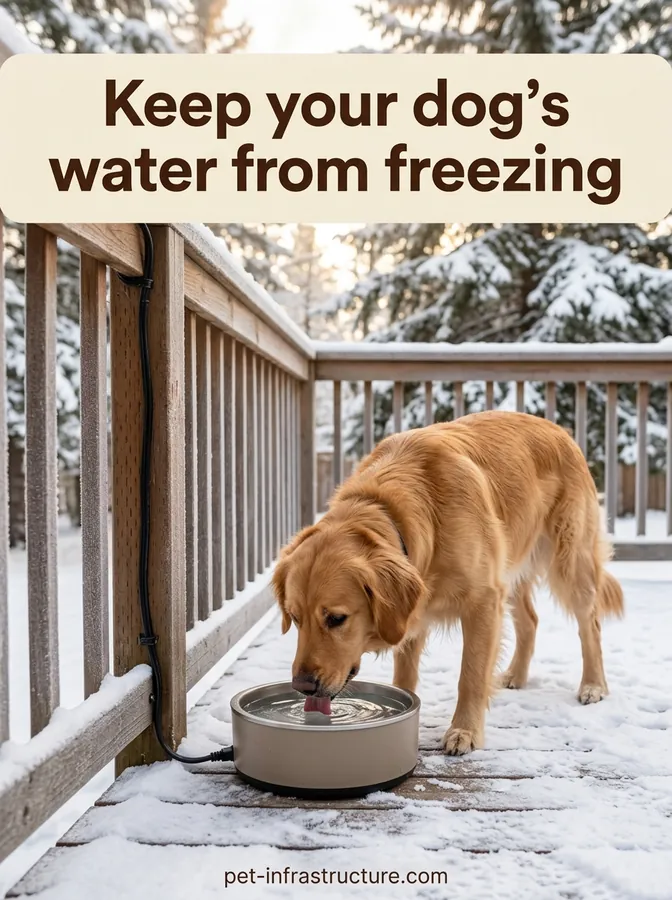
On a freezing night, a dog's outdoor water bowl can turn to ice within a few hours. Dogs need to drink just as much in winter as in summer, as the AKC reminds owners, and snow is not a substitute for water. The reliable fix is a heated bowl. But a bowl that stays plugged in outdoors for months raises the questions most product pages skip: which size, how many watts, which outlet, and how to keep the cord away from teeth. This guide answers those, and covers what to do if there's no power where your dog drinks.
The short answer: use a thermostatic heated bowl sized for your dog, plugged directly into a GFCI-protected outdoor outlet, with the cord routed out of chewing reach. K&H's Thermal-Bowl range draws 12 to 25 watts depending on size, switches on only when needed and carries a MET safety listing; K&H says not to use it with an extension cord. Place the bowl out of the wind. Without power, use a deep rubber bowl in the sun, insulate it, and swap it for fresh water several times a day.
Heated bowls compared
| Bowl | Capacity | Material | Power | Good for |
|---|---|---|---|---|
| K&H Thermal-Bowl, 1.5 gal | 1.5 gallons | Plastic | Thermostatic, within K&H's 12–25 W range | Medium and large dogs |
| K&H Thermal-Bowl, stainless | Large | Stainless steel | 25 W, 3-prong plug | Dogs that chew plastic |
| Farm Innovators P-60 | 1.5 gallons | Plastic | 60 W | Large dogs, several dogs sharing |
| K&H Thermal-Bowl, 32 oz | 32 oz | Plastic | 12 W | Small dogs and cats |
Choosing the right heated bowl
Start with size. A bowl that runs dry by evening doesn't help, so pick one that holds at least a full day of water for your dog — or for all your dogs, if they share. Then look at three details:
- A thermostat. K&H's bowls use internal thermostats that switch the heater on and off as needed to keep the water from freezing over, rather than heating all the time.
- A safety listing. K&H's bowls are MET listed, MET being one of the recognized testing labs alongside UL and ETL. Look for that kind of mark on any bowl you'll leave plugged in outdoors.
- The material. Plastic is lighter and cheaper. Stainless steel resists a dog that chews or tips its bowl, and K&H's stainless model comes with a 3-prong plug.
Our choice for most dogs is the 1.5-gallon K&H Thermal-Bowl: it holds enough for a medium or large dog, and K&H says its range keeps water unfrozen even in sub-zero temperatures.
For a dog that chews plastic, the stainless version is the sturdier choice.
For several dogs or a very large one, the Farm Innovators P-60 holds 1.5 gallons at 60 watts — more power, so give it the same outlet care.
Outlet, cord and placement
A heated bowl is a small appliance sitting in water and weather all winter. These rules come from the maker and from the Electrical Safety Foundation (ESFi):
- A GFCI outlet. ESFi calls a GFCI "a lifesaver, not a luxury" outdoors, and recommends weather-protective covers that still close with a plug inserted. If your outdoor outlet isn't GFCI-protected, ask an electrician.
- No extension cord with K&H bowls. K&H's instructions say not to use one. If another maker allows it, ESFi says to use only cords marked "For Outdoor Use", and never cover or walk on them.
- The cord out of reach. K&H wraps its cords to resist abrasion and chewing, but the best protection is routing: along a wall, behind a post, or through a cord cover, where the dog can't get at it.
- Out of the wind. K&H recommends a sheltered spot, which also helps the bowl keep up on the coldest nights.
- Check it daily. A bowl that's tipped over or unplugged freezes like any other.
No power? what still works
Without an outdoor outlet, you can still slow freezing down:
- Deep rubber bowls. CAAT, a Canadian animal welfare group, recommends rubber: plastic cracks in the cold, and ice pops out of rubber easily. K&H notes that deeper bowls freeze more slowly than shallow ones.
- Sun and shelter. Put the bowl where it gets winter sun and is out of the wind, as CAAT suggests.
- Insulate it. Wrap the outside of the bowl or set it in an insulated box, leaving the water open.
- Swap bowls. K&H suggests rotating fresh water every few hours, since an outdoor bowl can freeze within a few hours.
- Never rely on snow. CAAT is clear that snow cannot replace liquid water.
If your dog also sleeps outside, the same outlet and cord rules apply to heated beds — see our guide to heated dog beds and dog house heaters.
Frequently asked questions
How do I keep my dog's water from freezing outside?
Use a thermostatic heated bowl sized for your dog, plugged directly into a GFCI-protected outdoor outlet, with the cord out of chewing reach and the bowl out of the wind. Without power, use a deep rubber bowl in the sun, insulate it and replace the water several times a day.
Are heated dog bowls safe?
Bowls designed for outdoor pet use, with a thermostat and a recognized safety listing such as K&H's MET-listed Thermal-Bowl, are built for it. Plug them into a GFCI-protected outlet, follow the maker's rule on extension cords — K&H says not to use one — and keep the cord where your dog can't chew it.
How do I keep water from freezing without electricity?
Use a deep rubber bowl, which freezes more slowly and releases ice easily, place it in the sun and out of the wind, insulate it, and swap in fresh water every few hours. Snow is not a substitute for water.
How many watts does a heated dog bowl use?
K&H's Thermal-Bowls use 12 to 25 watts depending on size, and switch on only when needed. Larger bowls such as the Farm Innovators P-60 draw 60 watts.
Keep reading
- More articles like this one — buying, running costs and living with these machines.
- The troubleshooting library — if something is actually broken right now, start there instead.

Written by Alberto Guardia
I’m a physician working in medical informatics, and I run Pet Infrastructure on my own — no team, no manufacturer sponsorship, no paid placements. I share my home with Wolfgang, a 13-year-old Chartreux with firm opinions about litter and none whatsoever about firmware.
How this article was put together. Every figure, spec and claim here is traced back to the manufacturer’s own documentation, to official support articles, or to several owner reports that agree with each other — and the article tells you which. Where something genuinely isn’t documented anywhere, I say so instead of filling the gap.
How I check everything I publish → · Last updated October 2026