Heated dog bed or dog house heater: what's actually safe
When nights drop below freezing, a dog that sleeps in a kennel, a garage or a dog house needs more than a blanket. You have three ways to add warmth: a heated bed or pad, a heater mounted in the dog house, or a self-warming bed with no electricity at all. They don't carry the same risks. Most "best heated dog bed" lists skip the part that matters most outdoors: the wattage, the safety listing, the outlet and the cord. This guide puts that part first.
The short answer: for most dogs, a thermostatic heated bed designed for outdoor use is the safest way to add heat. Models such as K&H's warm to about 102°F only while the dog lies on them, draw 20 to 60 watts, carry a safety listing and have a steel-wrapped cord. A wall-mounted dog house heater warms the air instead, draws far more power — 400 watts for the Hound Heater — and needs a GFCI-protected outlet. A self-warming bed uses no electricity and suits dogs that chew. Never use a human heating pad, a space heater or a heat lamp: the AVMA advises avoiding space heaters and heat lamps because of the risk of burns and fire.
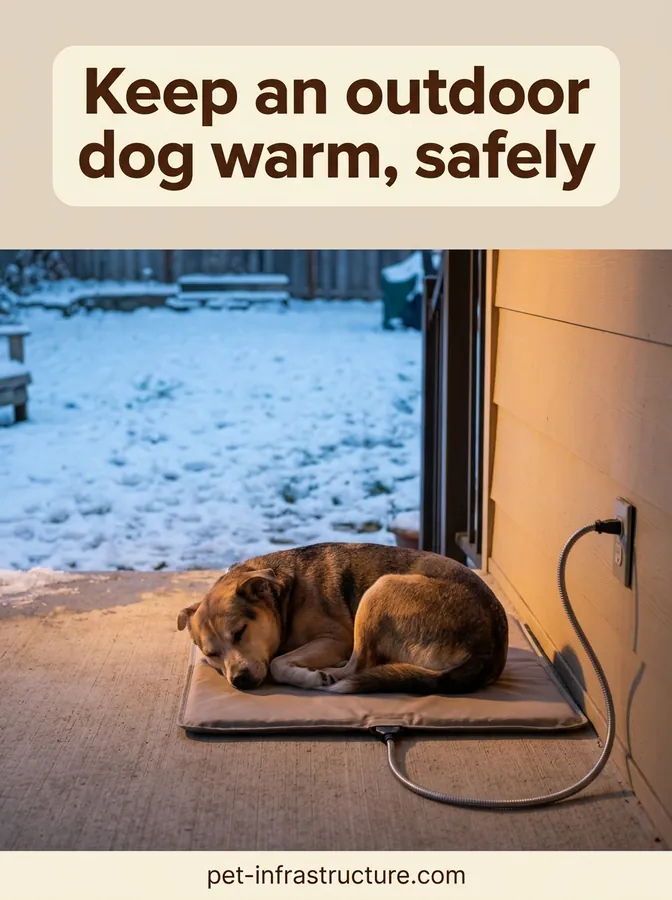
Three ways to keep a dog warm, compared
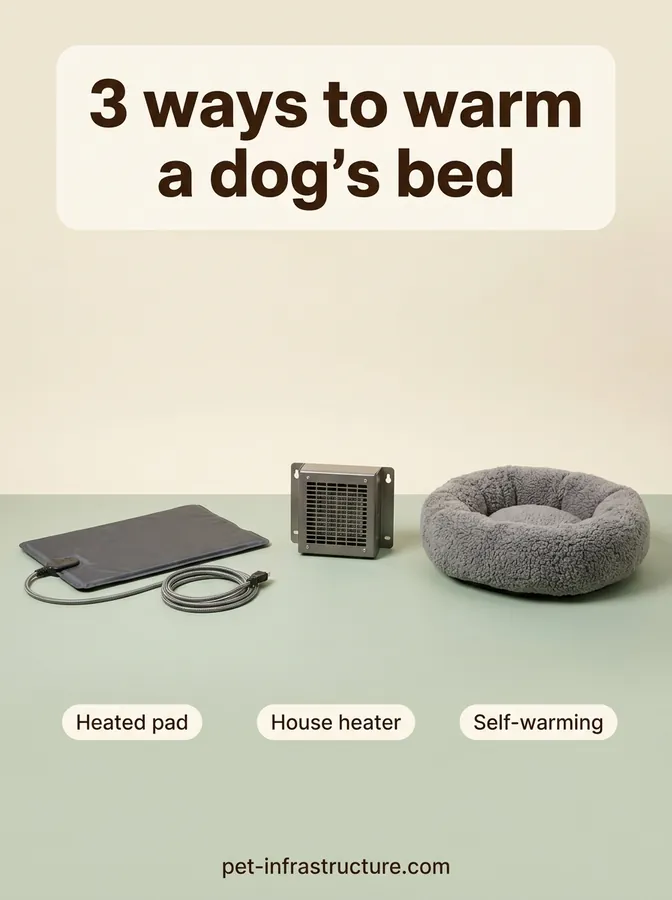
| Type | What it heats | Typical power | Best for | Watch out for |
|---|---|---|---|---|
| Thermostatic heated bed or pad | The surface the dog lies on, to about 102°F | 20–80 W (K&H, by size) | Kennels, garages, barns, sheltered porches | Dogs that chew; dogs that can't move off the heat |
| Dog house heater | The air inside an insulated dog house | 400 W (Hound Heater) | An insulated dog house in hard winters | Higher power; mounting rules; check the safety listing |
| Self-warming bed | Nothing — it reflects the dog's own heat | None | Chewers, no outlet nearby, milder cold | Only works if it stays dry |
Heated beds and pads
A heated dog bed made for outdoor use is not a heating pad. The K&H Lectro-Soft Outdoor Heated Bed, for example, uses a thermostat that warms the bed to about 102°F — close to a dog's own temperature — only when the dog lies on it. It draws 20, 40 or 60 watts depending on size, about the same as a light bulb. Its cord is 5.5 feet long and wrapped in steel, and the bed is certified by MET Labs, one of the recognized testing laboratories. K&H's heavier-duty Lectro-Kennel pad works the same way at 40 to 80 watts.
K&H is just as clear about the limits. Its instructions say not to use the bed with an extension cord, that the dog must always be able to get off it, and that it's not recommended for destructive dogs. For puppies or dogs recovering from illness, K&H says to ask your vet first.
Dog house heaters
A dog house heater doesn't warm the floor. It's a small wall-mounted furnace that warms the air inside an insulated dog house, with its own thermostat. The best-known, the Hound Heater from Akoma, runs at 400 watts — several times a heated bed. On the Deluxe model, the thermostat has two ranges, 32–50°F and 50–80°F, and the cord runs through a metal cover.
The rules are stricter here. The Hound Heater mounts on a side wall only, not on the floor or the ceiling, and its retailer specifies a GFCI-protected outlet. Akoma also advises against loose bedding in front of it and recommends an insulated dog house with a door flap. One point to check before you buy: a retailer lists the Hound Heater Deluxe as not UL listed. If a safety listing matters to you, and outdoors it should, ask the seller which lab certified the version you're buying. The listing below is the newer version with Wi-Fi and a camera.
Self-warming beds: no cord at all
A self-warming bed or insert has a reflective layer that sends the dog's own body heat back. No electricity means no cord to chew and no risk of burns, which the AKC points out as their main advantage. The Furhaven ThermaPup insert slips into an existing bed.
The catch is moisture. Like straw in a dog house, it only works while it stays dry, so keep it under cover and off the ground. For a dog that sleeps outside in serious cold, a self-warming bed is a complement, not a replacement for a proper shelter.
The safety checklist before you plug anything in
Whatever you choose, these checks matter more than the brand:
- A recognized safety listing. Look for a mark from a recognized testing lab — UL, ETL or MET — on the product itself. The Electrical Safety Foundation (ESFi) gives the same advice for any electrical product.
- A GFCI outlet outdoors. ESFi calls a GFCI "a lifesaver, not a luxury" outdoors, and electrical codes require them for outdoor and garage outlets in new homes. If your outlet doesn't have one, ask an electrician.
- No extension cord unless the maker allows it. K&H forbids extension cords with its heated beds and bowls. Where a maker does allow one, ESFi says to use only cords marked "For Outdoor Use".
- Cord out of reach. Choose a steel-wrapped or covered cord and route it where the dog can't chew it.
- Dry bedding. Wet bedding next to a heater makes a cold, damp bed. Use straw rather than blankets in a dog house, and replace it when it's wet.
- A raised, sheltered spot. The AVMA recommends shelter that is off the ground and out of the wind.
- A way out. The dog must always be able to move away from the heat. Ask your vet before using any heated bed for a dog that can't move easily.
Setting up a winter shelter for a cat too? The same rules apply — see our guide to the heated outdoor cat house.
What never to use
- Human heating pads. The AKC is explicit: don't use a human heating pad for a dog. Pet-specific beds are designed to stay at a safe temperature.
- Space heaters and heat lamps. The AVMA advises avoiding them for animals because of the risk of burns and fire.
Even approved heated mats aren't risk-free: the AVMA notes they can still cause burns, so check your dog and the bed regularly. And keep water liquid too — our guide on how to keep a dog's water from freezing outside covers the bowl side of winter.
Frequently asked questions
Are heated dog beds safe?
Beds designed for pets are much safer than human heating pads: models such as K&H's warm only to about 102°F while the dog lies on them and carry a safety listing. They still need a suitable outlet, no extension cord if the maker forbids it, and a dog that can move off the bed. The AVMA notes heated mats can still cause burns, so check regularly and ask your vet for dogs with limited mobility.
Is a dog house heater safe?
It can be, if it's designed for dog houses, mounted exactly as the maker says, plugged into a GFCI-protected outlet and kept clear of loose bedding. Check which lab has certified it: a retailer lists the Hound Heater Deluxe as not UL listed. Never use a space heater in a dog house.
How many watts does a heated dog bed use?
K&H's outdoor heated beds draw 20 to 60 watts depending on size, and its Lectro-Kennel pads 40 to 80 watts — similar to a light bulb. A wall-mounted dog house heater such as the Hound Heater draws 400 watts.
Can I use an extension cord with a heated dog bed?
Not with K&H's beds and pads: the maker says not to use an extension cord. If another maker allows one, ESFi recommends only cords marked "For Outdoor Use", and a GFCI-protected outlet outdoors.
Keep reading
- More articles like this one — buying, running costs and living with these machines.
- The troubleshooting library — if something is actually broken right now, start there instead.

Written by Alberto Guardia
I’m a physician working in medical informatics, and I run Pet Infrastructure on my own — no team, no manufacturer sponsorship, no paid placements. I share my home with Wolfgang, a 13-year-old Chartreux with firm opinions about litter and none whatsoever about firmware.
How this article was put together. Every figure, spec and claim here is traced back to the manufacturer’s own documentation, to official support articles, or to several owner reports that agree with each other — and the article tells you which. Where something genuinely isn’t documented anywhere, I say so instead of filling the gap.
How I check everything I publish → · Last updated October 2026