Heated outdoor cat house: what actually keeps a cat warm in winter
Whether it's your own indoor-outdoor cat, a barn cat, or the neighborhood cat you've been feeding since summer, the first frost raises the same question: is a heated outdoor cat house worth it, or is a box full of straw enough? The honest answer is that heat helps, but it's not what does most of the work. A shelter that stays dry, small and out of the wind keeps a cat warm on its own. Heat is the upgrade on top of that — and it only works if the rest is right.
The short answer: an outdoor cat stays warmest in a small, raised shelter, about 2 by 3 feet, with an entrance 5½ to 6 inches wide turned away from the wind, filled loosely with straw — never hay or blankets, which hold moisture. A heated outdoor cat house or heated pad adds a floor kept near a cat's body temperature, around 102°F, using only 20 to 40 watts. It should be plugged straight into a suitable outlet, without an extension cord, and kept under cover because it's water-resistant, not waterproof.
What a heated cat house actually does
A heated outdoor cat house isn't a heater. The common models from K&H Pet Products have a low-power heated pad built into the floor, around 20 watts for the Thermo Outdoor Kitty House. Thermostats keep the pad at roughly a cat's body temperature, about 102°F, while a cat lies on it, and let it cool when the cat leaves. It won't warm the air in the house the way a space heater would. What it does is stop the cold ground from drawing heat out of a sleeping cat.
That's why the shelter around the pad matters so much. A warm floor inside a drafty, damp box still leaves a cold cat. A warm floor in a small, dry, sheltered box is what makes the difference on the coldest nights.
Get the shelter right first
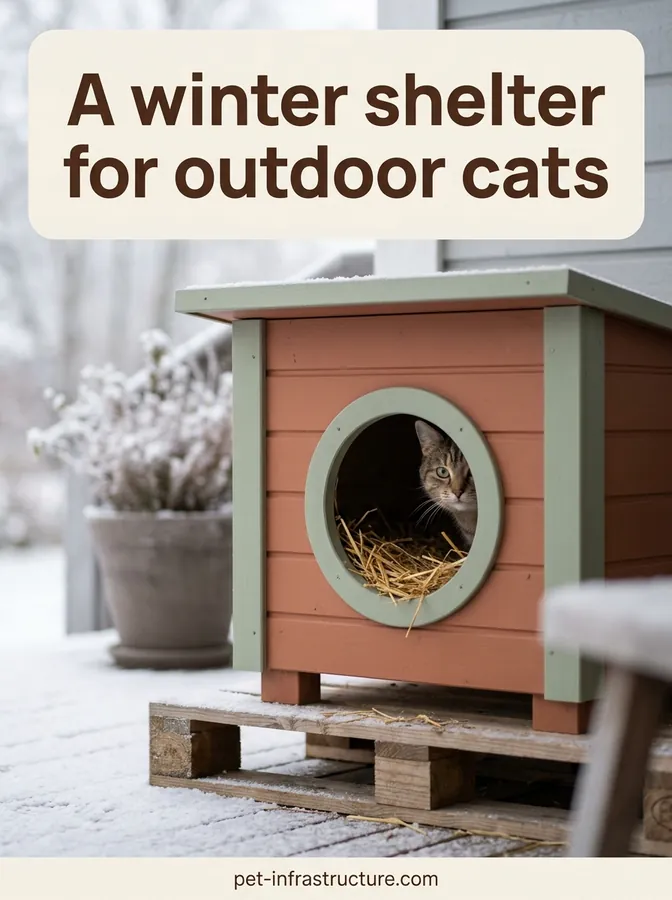
Rescue groups that build thousands of shelters for community cats agree on a few points, and they apply to a store-bought house just as much as to a DIY one.
- Small beats big. Alley Cat Allies suggests a shelter around 2 feet by 3 feet and at least 18 inches high. A bigger box has more air to warm, and a cat's own body heat can't keep up.
- A small entrance. ASPCApro recommends an opening about 5½ to 6 inches wide, roughly the width of a cat's whiskers. It lets a cat in and keeps larger animals out. A flap over the door holds in warmth.
- Off the ground. Raise the shelter on a pallet or a few bricks, and tilt it slightly so rain and melting snow drain away instead of pooling underneath.
- Entrance away from the wind. Turn the door away from the direction the wind usually comes from. Facing a wall, a few inches away, is ideal.
- Insulate the floor. In a DIY tote shelter, a thin slab of foam board under the bedding makes a real difference.
No budget for a ready-made house? Rescue groups build most of their shelters from a large plastic storage tote: line it with foam board, cut a doorway about 6 inches wide, and fill it loosely with straw. Alley Cat Allies publishes step-by-step instructions, and it's a good first shelter while you decide whether heat is worth adding.
If you're setting up a shelter for your own cat next to the house, the same logic applies to the door they use to come in. Our guide on how to stop drafts through a pet door covers that side of winter.
Straw, not hay — and no blankets
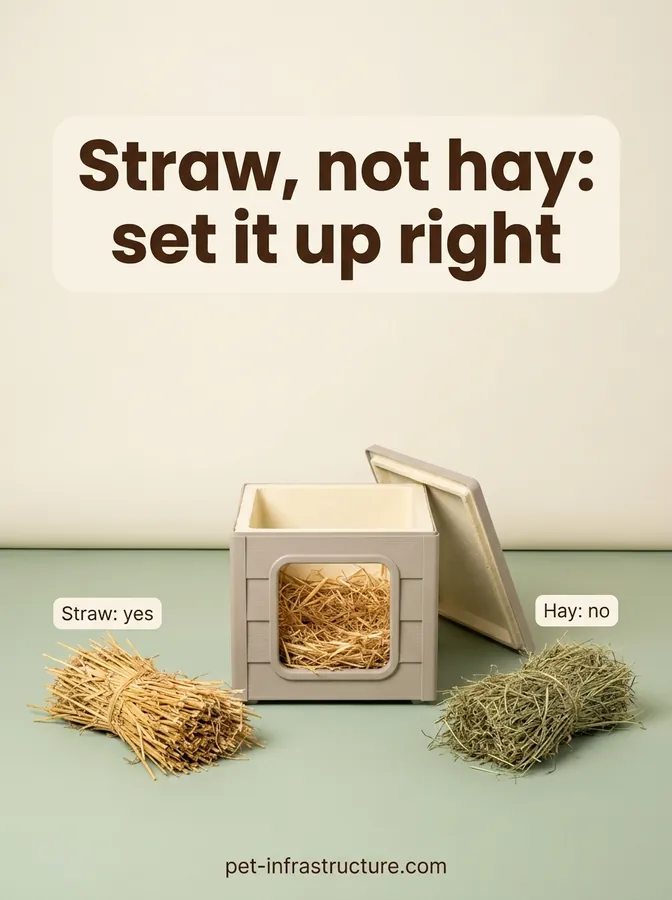
This is the mistake almost everyone makes, with the best intentions. Blankets and towels feel cozy, but Alley Cat Allies is blunt about them: they soak up moisture like a sponge and make the shelter wet and cold. Hay looks the same as straw but behaves the opposite way. It absorbs moisture, gets cold, and can go moldy.
Straw repels moisture and lets a cat burrow into a warm pocket. Fill the shelter loosely, about a quarter to half full, and replace it if it gets damp or dirty. Alley Cat Allies also suggests lining the shelter with a Mylar emergency blanket, which reflects body heat back toward the cat, with straw on top.
Choosing a heated house or a heated pad
You have two ways to add heat. Which one fits depends on whether you already have a shelter.
If you're starting from nothing, a ready-made heated house saves the most effort. The K&H Thermo Outdoor Kitty House is small, has two exits with clear flaps — so a cat is never cornered — and draws only 20 watts. It's water-resistant rather than waterproof, so it still belongs under a porch roof, in a shed or against a sheltered wall, not in an open yard where water collects.
If two cats share a shelter, the extra-wide version gives them room to sleep side by side. Only choose it if they really do sleep together: a bigger box is harder to keep warm for a single cat.
If you already have a shelter — a DIY tote, a box in the barn, a corner of the garage — a heated pad is the cheapest way to add heat. The K&H Extreme Weather Kitty Pad draws 40 watts, uses the same body-temperature thermostats, and its cord is wrapped in steel to resist chewing. Put it under a thin layer of straw rather than on top of it, so the cat still gets the benefit of both.
No outlet nearby? An unheated shelter, properly filled with straw and set up as described above, is still what rescue groups rely on for most community cats. Heat is a bonus, not a requirement.
Power and safety outdoors
Most owners' worry is fire. The manufacturer's answer is in the design: the pads don't get much warmer than a cat, the thermostats only hold that temperature while the cat is lying on it, and the products carry a MET safety listing. That doesn't remove the need for common sense.
- No extension cord. K&H says not to use an extension cord with its heated products. Plan the shelter's position around an outdoor outlet that the 5.5-foot cord can reach.
- Keep water away from it. These products are water-resistant, not waterproof. Keep them under cover and away from spots where water pools or snow drifts in.
- Check the cord. Look along the cord every few weeks for chew marks or damage, especially if other animals come around.
- Keep bedding dry. Wet straw next to a heated pad still makes a cold, damp shelter. Replace it whenever it gets wet.
If you're unsure whether your outdoor outlet is suitable for a device left plugged in all winter, ask an electrician. It's a one-time check for a setup that runs every night for months.
Keep food and water from freezing
A warm shelter doesn't help much if the water bowl is a block of ice by morning. Alley Cat Allies suggests a few simple fixes:
- A heated water bowl. The most reliable answer where you have an outdoor outlet — same rule as the shelter, no extension cord if the maker says so.
- Insulate the bowl. A layer of foam under the dish slows freezing, and a microwavable heating pad under the bowl buys a few extra hours where there's no power.
- A covered feeding station. A simple roof over the food and water keeps snow out and gives the cat a sheltered spot to eat. Place it near the shelter, but not right at its entrance.
For the bowl itself, K&H's Thermal-Bowl is built for this job: internal thermostats switch it on only as needed to stop the water freezing, the 32 oz cat version draws as little as 12 watts, and the cord is wrapped to resist chewing.
Have a dog outside as well? The same rules apply to its bowl and its bed: see how to keep a dog's water from freezing outside and our guide to heated dog beds and dog house heaters.
Other winter hazards around the house
Cold-weather advice from rescue groups always ends with the same three checks, and they're worth a minute of your time:
- Car engines. Cats climb into engine bays and wheel wells for warmth. Knock on the hood or honk before starting the car on cold mornings.
- Antifreeze. It tastes sweet to animals and is highly toxic. Clean up any drip on the driveway right away and store containers tightly closed.
- Ice melt. Some de-icing salts irritate paws. Around the shelter and the door your cat uses, choose a product labelled pet-safe.
Frequently asked questions
Do heated outdoor cat houses really work?
Yes, if the shelter around them is right. A heated cat house warms the floor to about a cat's body temperature while the cat lies on it, which stops the cold ground from pulling heat away. It works best in a small, raised shelter with dry straw and an entrance facing away from the wind.
Is straw or hay better for an outdoor cat shelter?
Straw. It repels moisture and lets cats burrow into it, while hay soaks up moisture, gets cold and can mold. Rescue groups also advise against blankets and towels for the same reason: they hold water and make the shelter colder.
Can I use an extension cord for a heated cat house?
K&H Pet Products says not to use an extension cord with its heated products. Place the shelter within reach of a suitable outdoor outlet instead, and keep the cord protected from water and chewing.
How do I keep an outdoor cat's water from freezing?
Use a heated water bowl where there's a suitable outlet. Without power, put foam or a microwavable heating pad under the bowl and shelter it under a roof. Check it every morning on freezing nights.
How big should an outdoor cat shelter be?
Smaller than most people expect. Alley Cat Allies suggests about 2 feet by 3 feet and at least 18 inches high, with an entrance roughly 5½ to 6 inches wide. A bigger shelter has more air to warm and stays colder.
Keep reading
- More articles like this one — buying, running costs and living with these machines.
- The troubleshooting library — if something is actually broken right now, start there instead.

Written by Alberto Guardia
I’m a physician working in medical informatics, and I run Pet Infrastructure on my own — no team, no manufacturer sponsorship, no paid placements. I share my home with Wolfgang, a 13-year-old Chartreux with firm opinions about litter and none whatsoever about firmware.
How this article was put together. Every figure, spec and claim here is traced back to the manufacturer’s own documentation, to official support articles, or to several owner reports that agree with each other — and the article tells you which. Where something genuinely isn’t documented anywhere, I say so instead of filling the gap.
How I check everything I publish → · Last updated October 2026