How to winterize a dog or cat door: find the draft and seal it
The first cold night of the season, you feel it: a thin stream of air along the floor, right from the pet door. Most advice on how to winterize a dog door jumps straight to buying a new one. But a pet door can leak in three different places, and only one of them is fixed by a new flap. Two minutes of checking tells you which one you have, and the fix is often cheaper than you'd think.
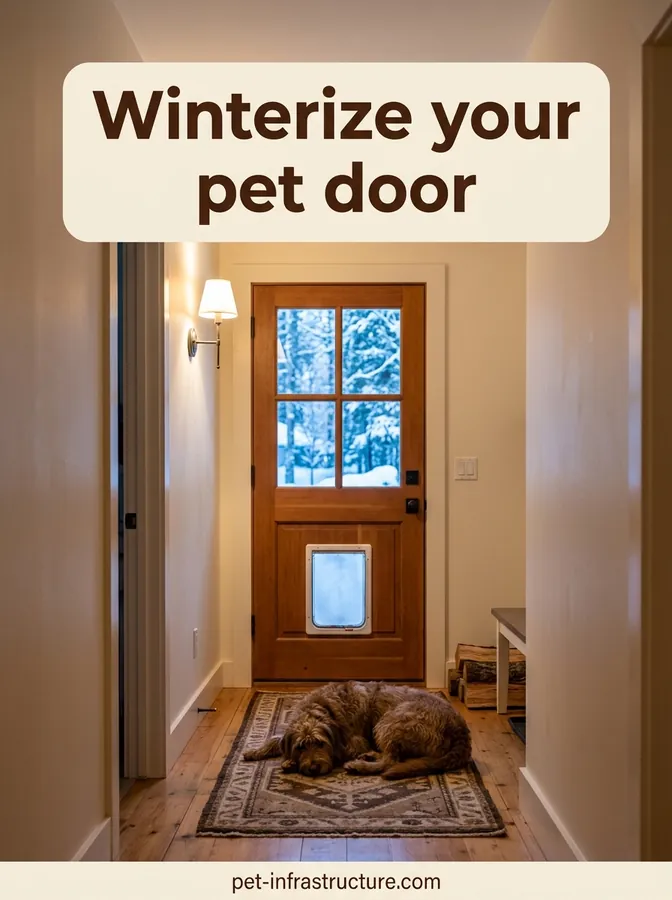
Find where the cold is getting in
Do dog doors let in cold air? Yes: any pet door is an opening in the outside of your house, and a standard single flap is one thin layer that doesn't always close completely. How much gets through depends on where your door leaks, and that is what this section helps you find.
A draft from a pet door almost always comes from one of three places:
- The flap itself — it no longer hangs flat, its magnets don't pull it closed, or the wind pushes it open.
- The frame — air slips between the pet door frame and the door or wall it's mounted in, or through the tunnel of a wall-mounted door.
- Around a patio insert — on a sliding glass door, the gap between the insert panel and the sliding door is often the biggest leak of all.
The quickest way to tell them apart is the test ENERGY STAR recommends for any air leak: light an incense stick and move it slowly around the edges of the suspected spot. Wherever the smoke wavers, gets pulled in or blows into the room, there's a leak. No incense? A damp hand works too: leaks feel noticeably cool. It's easiest on a cold or breezy day, when the difference between inside and outside is largest.
Check the flap edges first, then the seam where the frame meets the door or wall, then — if you have one — both sides and the top of a patio insert. Note where the smoke moves most, then match it here:
| Where it leaks | What you notice | The fix |
|---|---|---|
| The flap | Smoke moves at the flap edges; the flap is curled, swings freely or blows open in gusts | New flap, working magnet, windbreak outside — section 02 |
| The frame | Smoke moves along the seam between the frame and the door or wall | Caulk the fixed seam, weatherstrip where the flap or cover rests — section 03 |
| A patio insert | Smoke moves along the tall edge beside the sliding door, or at the top track | Clear silicone seal strip along the gap — section 04 |
| The door itself | Everything is sealed and it's still cold, often on a windy side of the house | Insulated double-flap door — section 07 |
The flap no longer seals or blows open in the wind
Look at the flap with the door closed and nobody using it. It should hang straight, touch the frame all the way along the bottom, and swing back and settle on its own after you push it. Three things break that.
Curled, cracked or stiff flaps. A flap that has curled at the corners, cracked, or no longer hangs flat can't close the opening, whatever else you do. There's no seal to rescue here — the flap needs replacing. On most doors that means removing a clamp bar with a screwdriver and swapping the flap; PetSafe's support guide for its Extreme Weather door walks through exactly that.
Weak or missing magnets. Most flaps are held shut by a magnet at the bottom that meets a strike plate on the frame. As one heating contractor put it to Homes & Gardens, standard flaps without magnets "often leave a tiny open gap." If your flap swings freely without snapping into place at the end, that's your problem. Some manufacturers, like Endura Flap, sell add-on magnet kits so you can adjust the strength; generic adhesive magnetic tape is a cheaper stopgap on flaps that have none.
One caution: stronger magnets mean more push. If your pet visibly has to shove harder to get through after you've added magnets, back off one step.
Wind blowing the flap open. On an exposed wall, a single light flap can simply be pushed inward by gusts, no matter how good its magnet is. Two things help. A heavier or double flap (see insulated double-flap doors), and — a tip that comes up again and again from owners in cold regions — something that breaks the wind outside the door: a fence panel, a shrub, even an angled board, so gusts don't hit the flap head-on.
If the flap is the leak, the least expensive real fix is a new one. Measure your existing flap and check your door's model number before ordering: PetSafe's flap finder lists which of its doors share each flap, and a flap that's a quarter-inch off won't seal.
Air leaking around the frame
This is the leak most people miss. As the same contractor told Homes & Gardens, even a brand-new magnetic flap may not reduce drafts "if the air leaks through the frame, not the flap itself." The incense test will show it: smoke moving along the seam where the pet door frame meets the door or wall, not at the flap.
The rule of thumb from state energy offices is simple: use caulk for gaps between parts that don't move, and weatherstripping where something opens and closes.
- Between the frame and the door or wall — nothing moves here, so it's a job for caulk. Run a bead of exterior-grade silicone caulk along the outside seam, and along the inside if the smoke test shows it. On a wall-mounted door, check the tunnel too: the joints between the tunnel sections and the wall opening can leak as much as the frame.
- Where the flap or cover closes against the frame — this part moves, so use weatherstripping. A thin self-stick rubber strip on the frame lip closes the gap the flap or locking cover leaves when it rests. Keep it clear of the magnet and its strike plate so they still touch.
Apply either one on a clean, dry surface. Adhesive strips stick best if you clean off pet hair and old residue first — the frame of a pet door collects more of both than any other door in the house.
Sliding glass door inserts and the gap beside them
If your pet door is a panel that sits in the track of a sliding glass door, the flap is rarely the main leak. The insert has to fit between the door frame and the sliding panel, and wherever those don't meet perfectly — usually along the tall vertical edge where the insert meets the sliding door, and at the top track — cold air walks straight in. It's a common enough problem that pet door retailers sell dedicated center-post draft stoppers for patio panels.
The fix owners report most often is simple: a strip of clear, self-adhesive silicone seal — the kind sold for glass shower doors — stuck along the insert's edge so it overlaps the sliding door and closes the gap. Some glue a strip of rubber to the insert frame to do the same. A wide clear strip has two advantages here: it covers an uneven gap, and you can barely see it against the glass.
Run the smoke test along the full height of that edge before and after — the difference is usually obvious. Then check the top of the insert where it sits in the track: that gap, if there is one, can take a thinner strip from the same roll or the rubber weatherseal above.
Still choosing a patio insert, or wondering whether a pet door built into the glass would be better? Our guide to the pet door for a sliding glass door compares both and explains how to measure your track.
Flaps that freeze or stiffen in the cold
In deep cold, a different problem shows up: the flap sticks. Owners in places like Calgary report that thicker flaps are more likely to freeze to the frame in heavy frost. The cause is usually moisture — condensation or melted snow brought in on paws — freezing between the flap and the frame or seals. It's the same thing that makes PlexiDor panels stick in winter, which we cover in our PlexiDor cold weather guide.
What helps: keep the frame and seals clean and dry, wipe away condensation when you see it, and free a stuck flap by hand rather than letting your pet force it. A flap that has gone permanently stiff or no longer returns flat after warming up has reached the end of its life — see the replacement section above.
Fixes for renters and for cold nights
If you rent, or simply don't want to drill or caulk, you still have options:
- Close it at night. Most pet doors come with a locking cover or closing panel. If your pet doesn't need to go out overnight, sliding it in cuts the biggest heat loss of the day. PetSafe's Extreme Weather Aluminum door and Endura Flap's door mounts, for example, both come with one.
- A magnetic curtain on the inside. An insulated curtain hung over the inside of the door is the renter's fix most often recommended by owners. A heavy thermal curtain works too, but expect your pet to need a few days to get used to pushing through fabric.
- Block it off entirely. If the door won't be used for the season, a cut-to-size panel of plywood or rigid foam over the opening, held with hook-and-loop tape or screws into the frame, stops the draft completely.
If your cat spends winter nights outside rather than coming in through the door, the same logic applies to where it sleeps: see our guide to the heated outdoor cat house and what actually keeps a cat warm.
Insulated double-flap doors for when sealing is not enough
If you've replaced the flap, sealed the frame and still feel cold air — or the door is on a windy side of the house — the door itself may be the limit. A single thin flap is a single thin layer.
Doors built for cold climates use two or three flaps with space between them. The trapped air pocket works a bit like double glazing, and the magnets seal on more than one edge. As one home inspector told Homes & Gardens, older single-flap doors "do not seal well"; layered flaps with magnetic or compression seals close tightly after each use. PetSafe's Extreme Weather door, for example, uses three separate flaps.
Endura Flap's double flap door is the one we'd look at first. Its flap is 7/8 of an inch thick, the magnets seal along every edge rather than just the bottom, and the manufacturer rates it for 50 mph winds and −40°F. It comes in sizes from Small to XL, with a locking cover included.
Before ordering any new door, measure your pet and compare the manufacturer's cut-out dimensions to your existing opening. If they don't match, you'll need to re-cut the door or wall — which is worth knowing before the box arrives.
Electronic and motorized pet doors
Microchip cat flaps and motorized dog doors need a lighter touch. Seal only the outside of the frame, where it meets the door or wall. Never run caulk, tape or weatherstripping across the flap's swing path, the locking mechanism, or the area around the reader — you'll stop the door from opening or confuse its sensors.
A few model-specific notes:
- Power Pet doors seal their sliding panel with brush seals in the guide tracks. When those wear, the door both leaks and starts stalling — replacing them fixes both, as covered in our Power Pet panel stall guide. If the door stops recognizing your pet's collar instead, see the Power Pet collar guide.
- PlexiDor doors are rated to −40°F; if the panel sticks in winter, it's almost always ice or dirt in the tracks, as covered in our PlexiDor guide.
- SureFlap microchip flaps: if yours starts misreading the chip or draining batteries, start with our Sure Petcare troubleshooting guide and the three spots to clean for battery life.
Frequently asked questions
How much cold air does a dog door let in?
It depends on the door's size, how well it seals and how exposed it is to wind, so there's no single figure. The published estimates are rough: Family Handyman cites Green Builder Media putting the extra heating cost of a thin-flap door at six percent a year or more, and a 2016 Grist column quotes one estimate of a few dollars a month for a leaky cat door. Treat both as orders of magnitude, not measurements. The incense test tells you more about your own door than either number.
How do you insulate a dog door?
Work from the cheapest fix up. Seal the seam between the frame and the door or wall with caulk, add a thin rubber weatherstrip where the flap or cover rests against the frame, and make sure the flap's magnet actually pulls it shut. On a sliding glass door insert, seal the gap beside the insert first. If the doggy door still lets cold air in after that, the single flap is the limit, and an insulated double- or triple-flap door is the next step.
How do you block off a doggie door for winter?
For nights, slide in the locking cover or closing panel that came with the door. For a whole season, cover the opening with a panel of plywood or rigid foam cut slightly larger than the frame and fixed over it, or hang an insulated curtain on the inside if you can't screw into anything. Keep the flap in place underneath so it's ready in spring.
How do I keep the wind from blowing my dog door open?
Start with the magnet: if the flap swings freely instead of snapping shut, it needs a working magnetic closure or a replacement flap. Then reduce the wind hitting it — a windbreak outside the door makes a real difference on exposed walls. If gusts still push it open, a heavier double-flap door rated for high winds is the lasting fix.
Do thicker pet door flaps freeze shut?
They can in heavy frost, mostly because moisture freezes between the flap and the frame. Keeping the frame dry and clean prevents most of it, and a flap that sticks should be freed by hand rather than forced by your pet.
Keep reading
- More articles like this one — buying, running costs and living with these machines.
- The troubleshooting library — if something is actually broken right now, start there instead.

Written by Alberto Guardia
I’m a physician working in medical informatics, and I run Pet Infrastructure on my own — no team, no manufacturer sponsorship, no paid placements. I share my home with Wolfgang, a 13-year-old Chartreux with firm opinions about litter and none whatsoever about firmware.
How this article was put together. Every figure, spec and claim here is traced back to the manufacturer’s own documentation, to official support articles, or to several owner reports that agree with each other — and the article tells you which. Where something genuinely isn’t documented anywhere, I say so instead of filling the gap.
How I check everything I publish → · Last updated October 2026