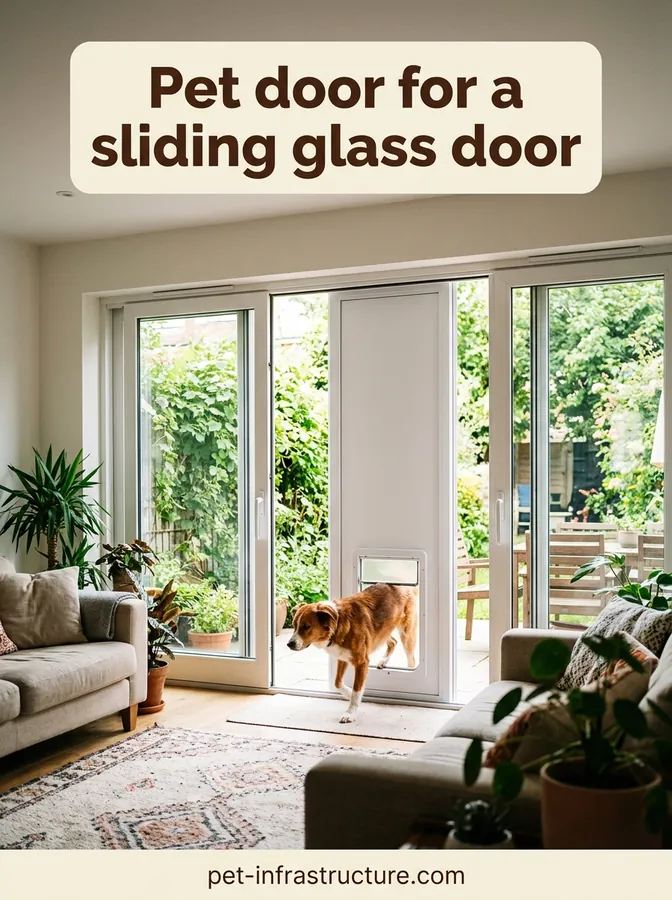
Pet door for a sliding glass door: insert panel or through the glass?
A sliding glass door is often the door your dog or cat actually uses — it opens onto the yard or the patio. But you can't simply cut a hole in it. There are two real ways to give your pet their own way out: a patio panel that stands in the door track next to the sliding panel, or a pet door built into a new glass pane by a glazier. One takes minutes and leaves no trace. The other looks cleaner and costs a great deal more. Here's how to choose, how to measure, and how to keep the door secure afterwards.
The short answer: for most homes, and for every renter, a patio panel insert is the right pet door for a sliding glass door. It stands in the existing track beside the sliding panel, adjusts to your door height, needs no cutting and comes out when you move. Measure the track height from the inside of the bottom track to the inside of the top track, pick the flap size by your pet's weight, and add a security bar, because the sliding panel can no longer lock against the frame. A through-glass pet door is neater but requires a new custom glass unit made by a glazier, since tempered glass can't be cut.
Two ways to put a pet door in a sliding door
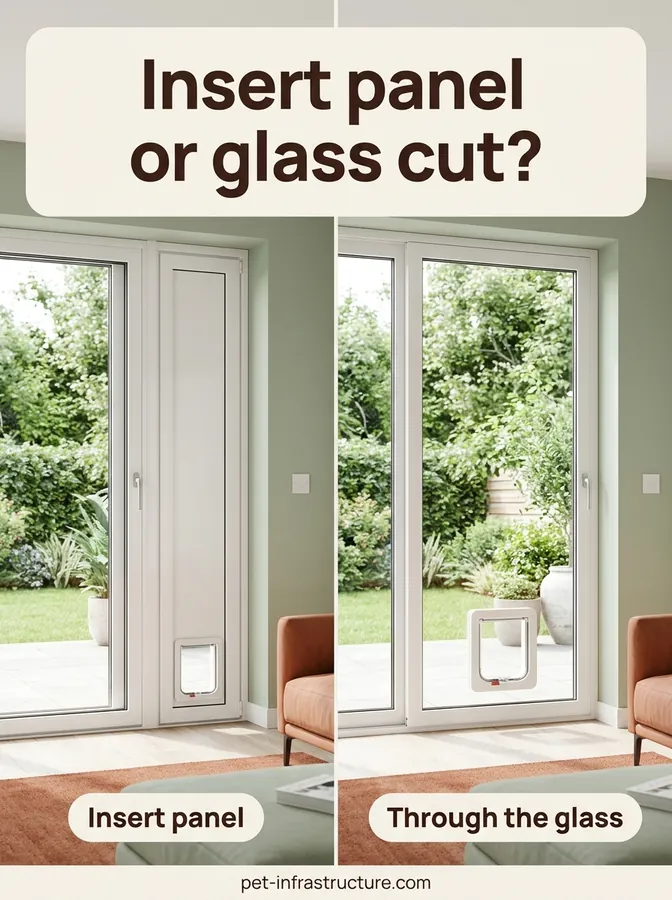
| Patio panel insert | Through-glass pet door | |
|---|---|---|
| How it works | A glass-and-aluminum panel with a built-in flap stands in the track; the sliding door closes against it | A glazier makes a new glass unit with the pet door built in and replaces your existing glass |
| Installation | Do it yourself, no cutting — screws are optional on PetSafe's Freedom panel | Professional only |
| Renters | Yes — it lifts out and leaves nothing behind | Only with the landlord's agreement |
| Door opening | You lose the width of the panel | Unchanged |
| Security | Needs a security bar or panel lock | The door keeps its normal lock |
How to measure your track
Everything depends on one number: the height of your door track. Panels are sold in height ranges, and a panel outside your range simply won't stand firmly.
Measure from the innermost point of the bottom track to the innermost point of the top track — the method Endura Flap gives for its panels. Measure at both ends of the track, since older frames aren't always level, and keep the smaller figure. If your measurement falls where two height ranges overlap, PetDoors.com's guide suggests choosing the range above it rather than below. Then match it to the panel's range: PetSafe's Freedom Patio Panel for standard doors covers heights from 75 7/8 inches, and its tall version covers 91 7/16 to 96 inches. Check the exact maximum on the listing you buy, as PetSafe and Amazon list slightly different upper limits for the standard model.
Check your door type too. PetDoors.com notes that doors running on a single rail (a monorail track) need an adaptor, and that on a door with two sliding panels, one of them has to stay fixed once the pet panel is in.
Choosing the flap size
Pick the flap for your largest pet. Weight gives you a first idea, but body size decides: as a rule of thumb from PetDoors.com, the top of the flap should sit at least an inch above the highest point of your pet's back, and the flap should be about two inches wider than the widest part of its body. PetSafe's Freedom panel comes in five sizes:
- Small — pets up to 15 lb, flap about 5¼ by 8 inches.
- Medium — up to 40 lb, flap about 8¼ by 12 inches.
- Large — up to 100 lb, flap about 10¼ by 16⅜ inches.
- Large Tall — up to 130 lb.
- Extra Large — up to 220 lb, flap about 13¾ by 23¾ inches.
A cat and a small dog can share a small or medium flap. If you have a large dog and a cat, size for the dog: cats learn a bigger flap quickly.
Which patio panel to buy
For most homes, the PetSafe Freedom Aluminum Patio Panel is the one to start with. It stands in the track with tension, the screws are optional, and it comes with a sweep for the bottom of the glass and a closing panel to shut the flap at night. The large version suits dogs up to 100 lb.
For harsh winters, look at insulated panels with two layers of glass and more than one flap. PetSafe's Extreme Weather Sliding Glass Pet Door uses double-pane glass and three insulated flaps, and Endura Flap's Thermo Panel is built for the same job with a much wider choice of heights. They cost noticeably more, and they're worth it mainly if the door faces the cold.
If drafts are already your problem, our guide on how to stop drafts through a pet door covers the gap beside the panel, which is where most of the cold gets in.
Keeping the door secure
This is the part most buyers don't think about until the first night. Once a panel stands in the track, the sliding door closes against the panel instead of the frame, so its own latch usually no longer locks. Anyone who can reach the door can slide it open.
The fix is simple: a security bar that stops the sliding panel from moving. PetSafe includes one with its Extreme Weather model and sells it separately for the others. Add the panel's own closing cover at night, and the door is as secure as it was before. A cut wooden dowel in the track or a hinged Charley bar does the same job for less, as PetDoors.com points out.
When a through-glass door makes sense
If you own your home and hate the look of a panel, a through-glass pet door is the clean alternative. It's not a DIY job. Sliding door glass is tempered, and tempered glass can't be cut once it's made — it shatters. A glazier cuts the opening in new glass before tempering, builds a new glass unit with the pet door fitted, and swaps it into your door. Flaps such as the SureFlap microchip cat door can be fitted in glass with an adapter.
Costs vary widely by glass size and type. Angi's 2026 cost guide puts sliding glass door pet door installation anywhere from about $150 for a simple insert up to $1,500, with labor a large share of the total on custom work. Get two quotes from local glaziers before you decide.
Frequently asked questions
Can you put a dog door in a sliding glass door?
Yes. The easiest way is a patio panel insert that stands in the sliding door track beside the moving panel, with the pet door built in. No cutting is needed. The other way is a new glass unit with a pet door built in, made and installed by a glazier.
How do I measure for a sliding glass pet door?
Measure the height of the track from the innermost point of the bottom track to the innermost point of the top track, at both ends, and keep the smaller number. Then choose a panel whose adjustable height range includes that measurement.
Are sliding glass pet doors secure?
A panel insert stops your sliding door from locking against the frame, so add a security bar that blocks the sliding panel, and close the pet door's cover at night. PetSafe includes a security bar with its Extreme Weather model and sells one separately.
Can I still use my sliding door with a pet panel in place?
Yes. The sliding panel still opens and closes as before, but it closes against the pet panel instead of the frame, so the opening is narrower by the width of the pet panel. You'll also need a security bar, because the door's own latch usually no longer locks.
Can I install a patio pet door if I rent?
Yes. A patio panel insert stands in the existing track under tension and needs no cutting or permanent change — on PetSafe's Freedom panel, the screws are optional. You take it with you when you move.
Keep reading
- More articles like this one — buying, running costs and living with these machines.
- The troubleshooting library — if something is actually broken right now, start there instead.

Written by Alberto Guardia
I’m a physician working in medical informatics, and I run Pet Infrastructure on my own — no team, no manufacturer sponsorship, no paid placements. I share my home with Wolfgang, a 13-year-old Chartreux with firm opinions about litter and none whatsoever about firmware.
How this article was put together. Every figure, spec and claim here is traced back to the manufacturer’s own documentation, to official support articles, or to several owner reports that agree with each other — and the article tells you which. Where something genuinely isn’t documented anywhere, I say so instead of filling the gap.
How I check everything I publish → · Last updated October 2026