Microchip cat feeder: how to stop one cat eating the other's food
Every multi-cat home has one: the cat that finishes its bowl in thirty seconds and then moves on to everyone else's. It's a nuisance when the food is the same. It's a real problem when one cat is on a special diet the vet prescribed, or when the dog treats the cat's bowl as a snack bar. A microchip feeder solves it with a lid that opens only for the right animal. It works well — as long as you pick the right type and set it up the way cats actually behave.
The short answer: to stop one cat eating another's food, feed each cat from a microchip feeder that opens only for its registered chip. The SureFeed Microchip Pet Feeder reads the implanted microchip, stores up to 32 pets and takes wet food, which suits prescription diets. The Connect version also weighs each meal in an app. Collar-tag feeders such as the PETLIBRO One RFID suit scheduled dry food only. Whatever you choose, put the feeder against a wall and train each cat with the lid's training mode.
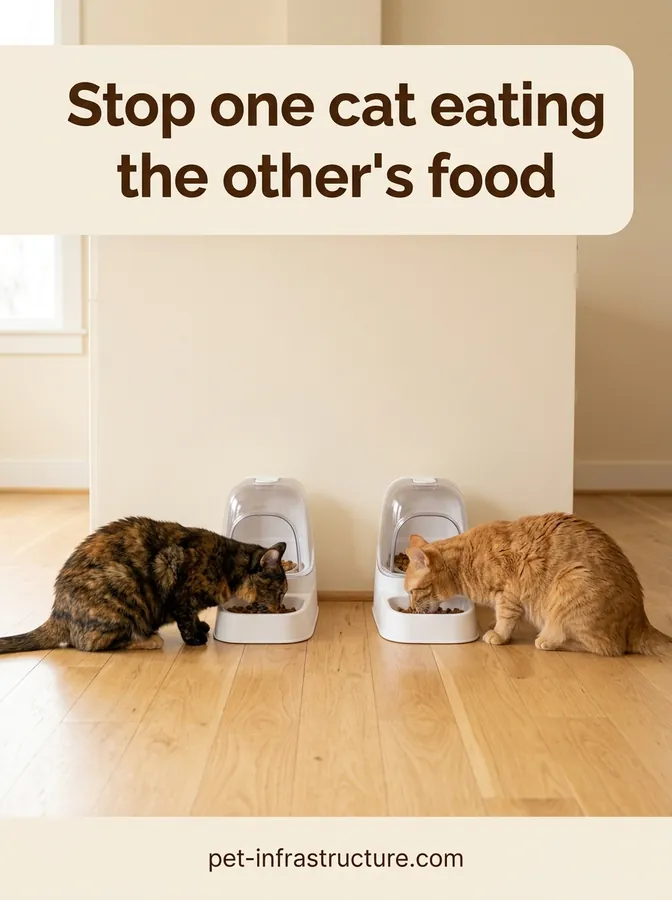
Try these first: the free fixes
If both cats eat the same food and nobody is on a special diet, you may not need a gadget at all. Vet-reviewed guides such as Catster's suggest a few free options first:
- Separate rooms at mealtimes. Feed each cat behind a closed door at set mealtimes, then pick up the bowls. It works, but only if someone is home at every meal.
- Different heights. A nimble cat can eat on a shelf or a cat tree that a heavier or older cat can't reach.
- A feeding box with a small door. A crate or a sturdy box with an opening only the smaller cat fits through keeps a bigger cat out.
These fixes break down when meals happen while you're out, when the cats are the same size, or when a prescription diet has to go to one cat and one cat only. That's where a microchip feeder earns its price.
How a microchip feeder works
A microchip feeder is a bowl under a lid, with a reader in the opening. You register a cat once by letting it put its head in. After that, when that cat comes to eat, the reader recognises its microchip and the lid slides open. Any other animal finds the lid closed.
There are two families, and the difference matters:
- Feeders that read the implanted microchip, like the SureFeed. Your cat needs nothing extra — the chip your vet or shelter already placed is its key.
- Feeders that read only a collar tag, like the PETLIBRO One RFID. The cat wears a small tag on its collar. No collar, no access.
| Feeder | Opens for | Food | Power | Pets |
|---|---|---|---|---|
| SureFeed Microchip Pet Feeder | Implanted chip or included tag | Wet and dry, 400 ml | 4 x C batteries | Up to 32 |
| SureFeed Connect | Implanted chip or tag | Wet and dry, weighs each meal | Batteries + Sure Petcare Hub | App meal log |
| Closer Pets MiBowl | Implanted chip or included tag | Wet and dry, 350 ml | 4 x C batteries | Up to 10 |
| PETLIBRO One RFID | Its own collar tag only | Dry food, 3 L hopper | Mains, batteries as backup | One tag per feeder |
The surefeed: the reference for wet food
The SureFeed Microchip Pet Feeder from Sure Petcare is the model most owners end up with, and for good reasons. Sure Petcare says it's compatible with all identification microchips, and it comes with one RFID collar tag for a cat that isn't chipped. It remembers up to 32 pets, and keeps them in memory even when you change the batteries.
The detail that matters most for special diets: its sealed 400 ml bowl takes wet food as well as dry — Sure Petcare describes it as two pouches of wet food — and the closed lid keeps food fresher and away from flies. It runs on four C batteries, which Sure Petcare rates at about six months. Some owners report closer to three.
Getting a cat used to a lid moving next to its face is the part people worry about. The feeder has a training mode that closes the lid in stages, so the cat gets used to the movement and the sound gradually. Plan for this to take a while, and don't rush it — a cat that gets startled early can refuse the feeder altogether.
When you need to know how much each cat ate
The SureFeed Microchip Pet Feeder Connect adds the one thing the standard model can't tell you: how much each cat actually ate. It has built-in scales, accurate to about a gram according to Sure Petcare, and the Sure Petcare app shows when each cat ate, for how long, and how much. You can also set a delay before the lid closes, which helps with a cat that lingers.
It needs the Sure Petcare Hub plugged into your router. If you already use a SureFlap Connect cat flap, you probably have one. It's the right choice when a diet is being monitored and you want numbers rather than guesses. If your Hub gives you trouble, our Sure Petcare troubleshooting guide covers the usual fixes.
Another microchip-reading bowl, the Closer Pets MiBowl, registers up to 10 pets and also takes wet and dry food. It's widely sold in Europe. Check availability where you live before you plan around it.
Collar-tag feeders: fine for dry food only
The PETLIBRO One RFID looks like the same idea at first. It's not quite. By PETLIBRO's own description, it only works with its dedicated collar tag, not with implanted microchips, and it's a dry-food feeder with a 3-liter hopper and scheduled meals through an app. PETLIBRO also asks for at least 10 inches between two of these feeders.
That makes it a good fit if what you want is portion-controlled dry food on a schedule, one feeder per cat, and your cats wear collars reliably. It's not the answer for a wet prescription diet, or for a cat that loses its collar every other week.
Setting it up so the thief can't win
Most "it doesn't work" stories are placement stories. Owners report a determined cat eating from the side or the back of a feeder, or simply forcing its way in behind the rightful owner.
- Back against a wall. Place the feeder so the only way to reach the bowl is through the front opening.
- Space between feeders. Don't line two feeders up side by side where the thief can reach across. PETLIBRO's 10-inch minimum for its own feeders is a sensible rule of thumb for any brand.
- Train each cat separately. Use the training mode, one cat at a time, and only switch to full operation once each cat eats calmly with the lid moving.
- Watch the first week. Sit nearby for a few meals. You'll quickly see whether the thief has found a way in, and whether the lid delay needs adjusting on a Connect model.
- A cat that shoves in anyway. Owners on Floppycats report putting the feeder inside a crate, so the only way in is one cat at a time through the front.
- Keep the reader clean. If the feeder stops recognising a cat, clean the sensor area and move it away from metal or other electronics before assuming it's faulty.
A dog is a different problem. Sure Petcare markets the SureFeed for cats and small dogs; it's not built to stop a large, determined dog. If the dog is the thief, feeding the cat somewhere the dog can't reach is still the most reliable fix.
And if the thief doesn't live with you at all — a neighbor's cat slipping in through the cat flap to empty the bowls — the fix is at the door, not the feeder. The SureFlap Microchip Cat Flap works on the same principle: it stores up to 32 pets, reads your cats' microchips, and keeps every other cat outside. It runs on four AA batteries, which Sure Petcare rates at up to 12 months.
Frequently asked questions
How do I stop one cat from eating the other cat's food?
Feed them separately with a microchip feeder, which opens only for the registered cat. Place it against a wall so the bowl can't be reached from the side, train each cat with the feeder's training mode, and watch the first few meals to make sure the other cat can't force its way in.
Does the SureFeed work with any microchip?
Sure Petcare says the SureFeed Microchip Pet Feeder is compatible with all identification microchips, and it includes one RFID collar tag for a cat that isn't chipped. It can store up to 32 pets.
Can a microchip feeder hold wet food?
The SureFeed can: its sealed 400 ml bowl takes wet or dry food. Collar-tag hopper feeders such as the PETLIBRO One RFID are designed for dry food only, so they don't suit a wet prescription diet.
Does my cat need to wear a collar for a microchip feeder?
Not with feeders that read the implanted microchip, such as the SureFeed or the Closer Pets MiBowl — the chip your cat already has opens the lid. Collar-tag feeders like the PETLIBRO One RFID need the tag on the collar at every meal.
Is the SureFeed Connect worth it over the standard model?
Only if you need to know how much each cat eats. The Connect weighs portions and logs meals in the Sure Petcare app, but it needs the Sure Petcare Hub. For simply keeping one cat out of another's bowl, the standard SureFeed does the job.
Keep reading
- More articles like this one — buying, running costs and living with these machines.
- The troubleshooting library — if something is actually broken right now, start there instead.

Written by Alberto Guardia
I’m a physician working in medical informatics, and I run Pet Infrastructure on my own — no team, no manufacturer sponsorship, no paid placements. I share my home with Wolfgang, a 13-year-old Chartreux with firm opinions about litter and none whatsoever about firmware.
How this article was put together. Every figure, spec and claim here is traced back to the manufacturer’s own documentation, to official support articles, or to several owner reports that agree with each other — and the article tells you which. Where something genuinely isn’t documented anywhere, I say so instead of filling the gap.
How I check everything I publish → · Last updated October 2026