Litter-Robot 4 vs 5 vs EVO: which one should you buy?
Whisker sells four self-cleaning litter boxes at four price points. This guide covers the three most people are actually choosing between — the camera-equipped 5 Pro is a separate tier, and a separate decision. The difference between the other three isn't just newer-is-better. The EVO is the smallest and cheapest for a reason, the 4 is the one most current owners actually have, and the 5 adds sensors that matter for some households and not others. Here's what actually separates them, so you're buying the one that fits your cats instead of just the newest one. One thing this guide deliberately leaves out is the money after day one: filters, liners and standby power run for as long as you own the machine, and they don't cost the same on every model. Our Litter-Robot running-cost calculator works out the one, three and five-year total for each of these three, at your own number of cats.
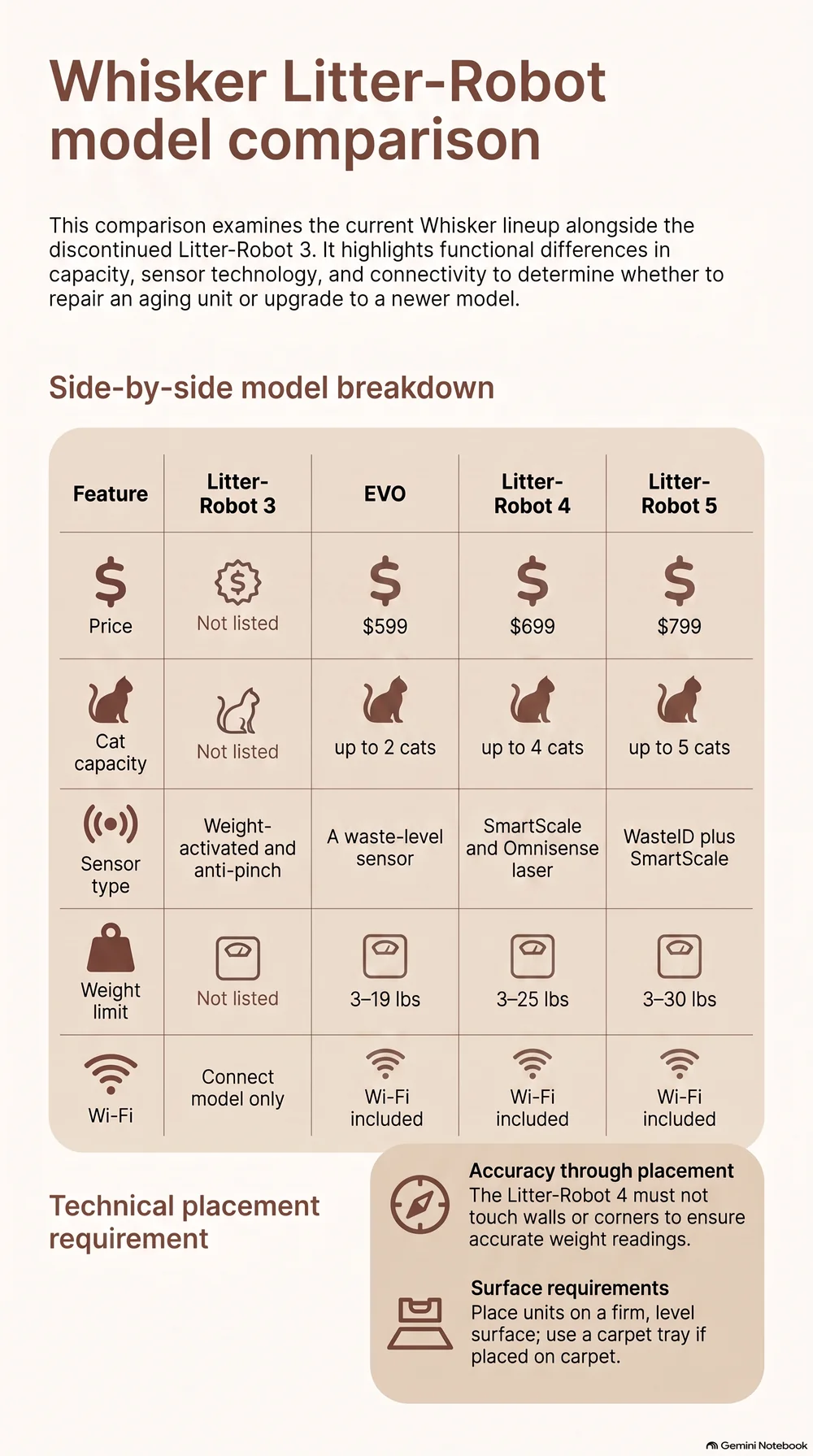
The three at a glance
| Model | Footprint | Cat capacity | Standout feature | Best for |
|---|---|---|---|---|
| EVO | The most compact of the three, with the smallest globe and the smallest litter fill | Best suited to one or two cats | The lowest step-in height in the lineup — 5.6 inches, against 6.9 on the 4 — at the lowest price | Small spaces, 1-2 cats, first-time smart litter box buyers |
| 4 | Noticeably larger than the EVO, with a wider weight range for bigger cats | Supports more cats than the EVO — Whisker's proven, best-selling model | A status light bar instead of a screen, and a carpet tray sold separately | Most households — the proven, best-value default |
| 5 | Same overall footprint as the 4, with a taller globe and a bigger waste drawer | Supports more cats than the 4, with a higher per-cat weight limit | WasteID, which tells urine and solid waste apart, plus a carpet tray built into the unit | Multi-cat households and health-pattern tracking |
Who the EVO is actually right for
The EVO isn't a stripped-down 4 — it's built smaller on purpose. The globe holds noticeably less litter than the 4 or the 5, and the whole unit takes up about 16 percent less floor space, which is the actual selling point if you're working with a small bathroom or a studio apartment rather than a mudroom. It still gets the same core mechanism as the other two: a sifting globe, an app, a waste-level sensor, and the option to use Whisker's OdorTrap packs in place of the standard carbon filter. It also has the same full-color LCD screen as the 5 — the 4 is the only model in the current lineup without one.
Its other quiet advantage is the step. All three models have one, but the EVO's is the lowest to climb: 5.6 inches, against 6.9 on the 4 and 7 on the 5. For an older cat, or one with stiff hips, that difference matters more than any sensor on the spec sheet. Our guide to the self-cleaning litter box for a senior cat compares every model's step and weight limits for older cats.
Where it falls short is capacity. Whisker rates it for up to two cats between 3 and 19 lbs, and Petful, comparing all four models side by side, points to it as the pick for apartment dwellers and first-time smart litter box buyers rather than established multi-cat households. If you've got more than two cats, or a cat on the larger side, this is the one to skip.
Why the 4 remains the default pick
The 4 has been on the market longer than the 5, and that shows up in two ways that matter more than a spec sheet: it's the model most existing troubleshooting knowledge, community experience, and accessory options exist for, and it's priced below the 5 without giving up the fundamentals — WiFi and app control, an automatic drawer-full sensor, and support for more cats and a wider weight range than the EVO.
It doesn't have the 5's WasteID waste-type sensor, and it shows its status through a colored light bar rather than a screen — you'll need to know what each color means, or check the app, rather than reading a plain-language prompt. Worth knowing before you use the screen as a reason to spend more: the cheaper EVO has an LCD too, so the 4 is the odd one out here, not the 5 that's ahead. Neither of those is a functional downgrade, just a difference in how the box communicates with you. If you don't have a specific reason to want the 5's extra sensors, the 4 remains the safer, better-proven buy for most households — see our full cost breakdown of the Litter-Robot 5 for the longer version of that argument. If you land on the 4, our litter compatibility guide and cleaning calendar cover what to do with it once it's set up.
When the 5 earns its higher price
The 5's real upgrade isn't cosmetic — it's WasteID, the sensor that tells the difference between urine and solid waste and times the cleaning cycle differently for each: it holds off after urine so the clump can form, and cycles quickly after solid waste to contain the smell.
That's a genuine reason to pick it over the 4 if you're watching a cat's litter box habits for early signs of a health issue. A change in how often a cat urinates is one of the earliest signals in several common conditions, and they don't all move in the same direction: chronic kidney disease and diabetes typically produce more urine and more drinking, while lower urinary tract disease typically produces frequent, difficult or painful trips. If those trips stop producing urine altogether, that's an obstruction and an emergency, not a trend. WasteID logs the trips and the waste type, which is what turns a vague sense that something's off into something you can show a vet. Two caveats worth having before you buy for this reason. On the standard 5, per-cat attribution is based on weight, so in a household where your cats weigh about the same it can't reliably tell you which one changed — that's the case for the 5 Pro and its camera. And a cat straining in the box without producing urine is a veterinary emergency, not a trend to watch in an app: that one goes straight to the clinic.
The 5 also has a taller globe, a bigger waste drawer that goes longer between emptying, and an integrated carpet tray you'd otherwise buy separately for the 4. None of that is essential if your current setup works, but together it's a real step up, not just a new coat of paint. If what actually draws you to the 5 is the built-in camera and cat recognition, that's a separate tier — the 5 Pro — worth reading about on its own before you decide. And if a rotating-drum machine like the PETKIT Pura Max is also on your shortlist, its running costs and warranty terms are different enough from Whisker's lineup to weigh separately.
Frequently asked questions
Is the Litter-Robot EVO good enough, or should I just get the 4?
If you have one or two cats and limited floor space, the EVO covers the same core self-cleaning function as the 4 in a smaller footprint, for less money. If you have more than two cats, or a larger cat, size up to the 4 — the EVO isn't built for that.
What's the single biggest difference between the Litter-Robot 4 and 5?
WasteID — the 5's ability to tell urine and solid waste apart and adjust its cleaning cycle accordingly. Everything else (bigger drawer, built-in carpet tray, taller globe) is a real but smaller upgrade. The LCD screen isn't one of them, despite how it's often framed: the cheaper EVO has one too, and the 4 is the only current model without.
Do I need the Litter-Robot 5 to monitor my cat's health?
No, but WasteID makes it easier. It's specifically useful for spotting changes in urination patterns, which can be an early sign of several common conditions — something a light bar or a manual scoop can't tell you. Two limits to keep in mind: on the standard 5, per-cat attribution is by weight, so cats of similar size can't reliably be told apart, and no litter box replaces a vet. A cat straining without producing urine needs a clinic the same day.
Which model supports the most cats?
Of the three compared here, the 5 has the highest cat capacity and the highest weight limit — Whisker rates it for up to 5 cats and 3 to 30 lbs, against up to 4 cats and 3 to 25 lbs on the 4, and up to 2 cats and 3 to 19 lbs on the EVO. The 5 Pro matches the 5 rather than exceeding it.
Keep reading
- More articles like this one — buying, running costs and living with these machines.
- The troubleshooting library — if something is actually broken right now, start there instead.

Written by Alberto Guardia
I’m a physician working in medical informatics, and I run Pet Infrastructure on my own — no team, no manufacturer sponsorship, no paid placements. I share my home with Wolfgang, a 13-year-old Chartreux with firm opinions about litter and none whatsoever about firmware.
How this article was put together. Every figure, spec and claim here is traced back to the manufacturer’s own documentation, to official support articles, or to several owner reports that agree with each other — and the article tells you which. Where something genuinely isn’t documented anywhere, I say so instead of filling the gap.
How I check everything I publish → · Last updated September 2026